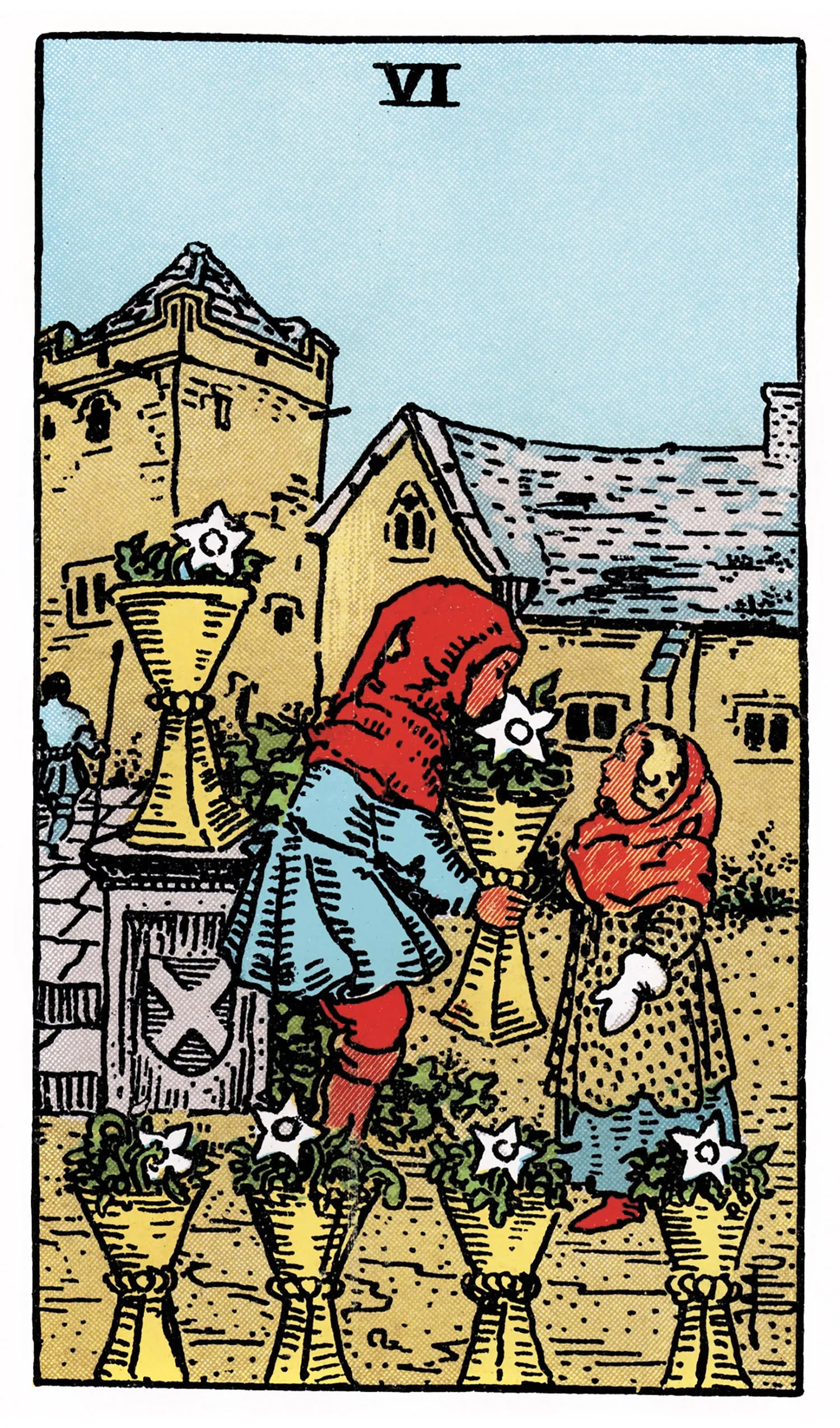
Minor Arcana · Cups · Six
The Six of Cups Tarot Card Meaning
The Six of Cups represents emotional comfort, restored harmony, familiar warmth, and the opportunity to recover after a difficult or destabilizing period.
After the tension of the Five, the Six does not necessarily solve every problem or produce a dramatic external breakthrough. Instead, it softens the situation. The pressure decreases, emotional safety begins to return, support becomes more available, and life enters a calmer and more comfortable phase.
The past is especially important in this card. Old friends, family, childhood memories, former relationships, familiar places, forgotten dreams, and previous sources of happiness may return because they remind the person what emotional security and belonging once felt like.
Card Meanings
General Meaning
The Six of Cups represents the restoration of emotional equilibrium after the disruption of the Five.
The Five disturbs the previous balance.
The Six allows that tension to settle.
This is one of the most important distinctions in the card.
The Six of Cups does not necessarily mean:
- the entire problem has been solved;
- every goal has been achieved;
- the situation suddenly turns into a major success;
- a dramatic positive event changes everything.
More often, it means:
the situation becomes easier to live with.
The emotional pressure decreases.
Conflict may quiet down.
People may become kinder toward one another.
Support appears.
The person may finally be able to rest.
Something familiar can restore a sense of safety.
The situation becomes more comfortable.
This is the central Six of Cups principle.
The Six Principle
Within TAROVERA, all Sixes represent restoration after the tension of the Fives.
Six is connected with:
- harmony;
- peace;
- balance;
- cooperation;
- relationships;
- satisfaction;
- domestic comfort;
- support;
- caring for others;
- receiving help;
- creative activity;
- rest;
- accumulation of strength.
Odd-numbered cards carry a more active, externally directed quality.
Even-numbered cards are more receptive and accumulative.
The Six therefore does not need to create a dramatic external movement.
Its strength is often internal.
The person can:
- calm down;
- recover;
- regain emotional stability;
- receive support;
- rebuild trust;
- gather strength;
- become more comfortable inside the situation.
The Sixes are also connected with the principle of The Lovers:
- partnership;
- cooperation;
- sincere friendship;
- meaningful relationships;
- choices made within connection;
- responsibility toward other people.
This reinforces the relational nature of the Six of Cups.
The person often recovers through connection rather than through struggle.
Comfort After The Five
If a spread has been difficult and the Six of Cups appears near the end, this should not automatically be interpreted as:
“Everything will work out perfectly.”
A more accurate interpretation may be:
“The situation will settle down.”
The conflict may become less intense.
The emotional atmosphere may soften.
The person may stop feeling constantly threatened or overwhelmed.
A relationship may become easier even if the underlying problem is not completely resolved.
A difficult circumstance may become more manageable.
The Six creates a breathing space.
It allows the person to regain strength before the next stage.
The Past as an Emotional Resource
The Six of Cups frequently turns toward the past because the past contains emotional reference points.
The person may remember:
- childhood;
- a happy period;
- an old friendship;
- a former relationship;
- family traditions;
- a familiar home;
- an old hobby;
- a previous dream;
- something that once made life feel meaningful.
The constructive purpose of the memory is:
“I have experienced happiness before, therefore I know that happiness is possible.”
This is different from:
“I was only happy then, so I need to go back.”
The first uses the past as a resource.
The second becomes trapped inside it.
The Six of Cups can therefore restore emotional confidence by reminding the person that warmth, trust, pleasure, creativity, and belonging are not foreign experiences.
Old Dreams and Forgotten Plans
The past may return not only through people and memories.
An old desire, project, dream, or plan may become relevant again.
Something the person once wanted but abandoned can return to consciousness.
The card may say:
“You already wanted this once.”
A forgotten creative ambition may wake up again.
An old professional idea may become useful.
A former interest may suddenly feel alive.
This does not guarantee that the old dream will now automatically succeed.
The important point is that the person reconnects with a part of themselves that had been forgotten.
The Past as the Root of the Present
The Six of Cups can also indicate that a current situation cannot be fully understood without examining its history.
A present reaction may have roots in:
- childhood;
- family relationships;
- a former partner;
- earlier disappointment;
- an old friendship;
- previous experience;
- learned emotional behavior.
The card can therefore answer not:
“What is coming back?”
but:
“Where did this begin?”
Sometimes the emotional logic of the present becomes clear only after the past is examined.
The Shadow Side of The Six of Cups
The shadow begins when comfort becomes stagnation.
The person may prefer what is familiar simply because the unknown feels frightening.
They may think:
- “Everything was better before.”
- “I was only happy when I was young.”
- “No one will ever compare with my ex.”
- “My family has always done things this way.”
- “I just want everything back the way it was.”
The past becomes an emotional standard that the present can never satisfy.
This can lead to:
- idealization;
- emotional immaturity;
- excessive nostalgia;
- refusal to adapt;
- dependence on family;
- staying in familiar but unsuitable relationships;
- avoiding adult responsibility;
- repeating childhood roles;
- hiding from the present.
Another shadow of Six is excessive care.
Support can become control.
A person may:
- interfere too much;
- decide for others;
- suppress another person's initiative;
- become offended when help is refused;
- expect gratitude;
- become jealous of another person's independence.
The deeper Six lesson is responsibility:
the more support, trust, love, or resources a person receives, the greater the responsibility to use them maturely.
The Six of Cups Reversed
The reversed Six of Cups shows a damaged relationship with the past, family, emotional security, or familiar patterns.
The person does not successfully use the past to restore harmony.
Instead, the past begins controlling the present.
Possible manifestations include:
- inability to adapt;
- painful memories;
- family conflict;
- emotional dependence;
- dependence on family rules;
- insecurity;
- emotional regression;
- desire to hide from the world;
- returning to immature behavior;
- repeating old relationship patterns.
The TAROVERA reversed-Cups principle also applies:
the rose-colored glasses come off.
The person may have remembered childhood, family, an ex, a former friendship, or an old home as much happier than it actually was.
Then they begin remembering:
- conflict;
- restriction;
- pain;
- emotional neglect;
- incompatibility;
- the reason the relationship ended;
- the reason they once wanted to leave.
The past turns out to be less innocent than memory made it appear.
The reversed Six can therefore produce the realization:
“I did not remember the whole story.”
There is also another reversed expression.
The person may not cling to the past visibly.
They may do the opposite:
run from it.
They may reject:
- family;
- old friends;
- their roots;
- childhood identity;
- familiar places;
- everything associated with a painful period.
But if their entire present life is built around:
“I must never become like them”
or
“I must get as far away from that past as possible,”
then the past still controls them.
Running from the past and living inside the past can be two versions of the same dependence.
Core Message
The Six of Cups restores emotional comfort after tension.
It can bring kindness, support, familiarity, rest, and a return of people, places, memories, or dreams connected with the past.
But its purpose is not necessarily to restore the past exactly as it was.
The deeper purpose is:
remember what emotional safety feels like, regain your strength, and use that memory to create greater comfort in the present.
The Six of Cups as a Person
The Six of Cups as a person describes someone warm, sentimental, kind, relational, and strongly connected with emotional memory.
They may:
- maintain friendships for many years;
- value family;
- remember meaningful details;
- keep sentimental objects;
- enjoy traditions;
- care for others;
- give gifts;
- enjoy making people comfortable;
- feel deeply attached to familiar places and people.
This person often has a strong inner child.
In the constructive sense, this does not mean immaturity.
It may mean:
- sincerity;
- openness;
- emotional spontaneity;
- simple joy;
- curiosity;
- playfulness;
- ability to enjoy small things;
- absence of unnecessary cynicism.
They may retain something emotionally fresh even after difficult experiences.
The Six of Cups person can also be creative.
When they feel safe, creativity flows more naturally because they no longer spend all their energy defending themselves.
Their inspiration may come from:
- memory;
- family history;
- childhood;
- old interests;
- sentimental experiences;
- familiar creative themes.
At their best, they give support without demanding control.
The Six of Cups as Actions
As Actions, the Six of Cups frequently shows restoring connection or creating comfort.
The person may:
- contact an old friend;
- message an ex;
- return home;
- visit family;
- revisit a familiar place;
- restore an old connection;
- offer support;
- give a gift;
- do something kind;
- help someone;
- return to an old hobby;
- reopen an old project;
- resume an abandoned dream.
It can also show courtship through small, thoughtful gestures.
The action is rarely aggressive.
It is more often:
“I want this to feel good and familiar again.”
The Six of Cups in Love and Relationships
The Six of Cups is strongly connected with emotional familiarity, warmth, tenderness, and shared history.
It can indicate:
- a former partner;
- an old romantic connection;
- someone already known;
- a childhood or school acquaintance;
- friendship becoming romantic;
- renewed contact;
- a reunion;
- a relationship with long shared history.
However:
return does not automatically mean successful reunion.
The card may simply indicate that the person or relationship belongs to the past and is becoming emotionally relevant again.
Emotional Comfort in Existing Relationships
In an existing relationship, the Six of Cups can show:
- warmth;
- tenderness;
- familiarity;
- domestic comfort;
- shared history;
- emotional safety;
- feeling that the partner is “home.”
It can also indicate that tension is calming after a difficult period.
This does not necessarily mean every relationship problem disappears.
It means:
the relationship becomes softer and more comfortable.
People may:
- stop fighting;
- become kinder;
- reconnect emotionally;
- remember why they once chose one another;
- enjoy simple time together.
Two Different Romantic Expressions
The Six of Cups can work at two very different levels.
One expression is light and youthful:
- innocent flirting;
- playful affection;
- sweetness;
- romantic gestures;
- gifts;
- gentle courtship;
- a relationship that feels emotionally young.
The other expression is based on deep history:
- people who have known each other for years;
- long-term emotional familiarity;
- relationships built on many shared memories;
- partners whose connection has become deeply integrated into their lives.
The card itself does not automatically tell us which version is present.
The surrounding cards and the actual question determine whether the relationship is pleasantly light, deeply established, or emotionally immature.
Relationships Held Together by History
The Six of Cups may also describe a couple whose connection is heavily supported by the past:
“We have been together for so long.”
“We have children.”
“We have lived through everything together.”
“We know each other better than anyone.”
This history can be a source of genuine strength.
But it can also become the only reason the relationship continues.
The important question is:
Is the relationship comfortable now, or are the people only attached to what it used to be?
The Six of Cups as Thoughts
The person's thoughts frequently return to earlier experiences.
They may think:
- “I remember how good it was.”
- “I wonder what they are doing now.”
- “We used to understand one another.”
- “I miss those days.”
- “Maybe we could try again.”
- “This reminds me of something from my childhood.”
- “I used to want this.”
The Six of Cups can also show that the person is mentally searching the past for the explanation to a current situation.
They may realize:
“This pattern did not begin today.”
The Six of Cups as Feelings
The Six of Cups usually indicates warm feelings.
These may include:
- tenderness;
- affection;
- trust;
- sympathy;
- fondness;
- emotional familiarity;
- nostalgia;
- missing someone;
- feeling emotionally safe with someone.
A common formula is:
“I miss you.”
But another equally important possibility is:
“I miss how I felt when I was with you.”
Sometimes the person misses the actual partner.
Sometimes they miss:
- youth;
- family feeling;
- safety;
- affection;
- the stage of life;
- the version of themselves they were then.
The Six of Cups is therefore affectionate, but it does not automatically guarantee overwhelming passion.
The Six of Cups as Intentions
The Six of Cups often intends to restore comfort or connection.
The person may want to:
- reconnect;
- meet again;
- reconcile;
- return;
- restore friendship;
- spend time together;
- give a gift;
- help;
- recreate a warm atmosphere;
- revisit something meaningful.
But familiar does not always mean compatible.
The person may want to return simply because the connection feels emotionally safe.
The Six of Cups as an Outcome
The Six of Cups as an Outcome means that the situation becomes more emotionally comfortable.
This is the most important TAROVERA Outcome distinction for the card.
It does not automatically mean:
- the entire problem is solved;
- the goal is completely achieved;
- there is a dramatic victory;
- the situation reaches its final successful conclusion.
Instead, it often means:
- tension decreases;
- conflict calms;
- support appears;
- the emotional atmosphere becomes softer;
- the person feels safer;
- communication becomes easier;
- the situation enters a more peaceful phase.
If the beginning and development of a spread are difficult and the Six of Cups appears as the final card, a realistic reading may be:
“The situation will calm down and become easier for you emotionally.”
That is different from:
“Everything will be resolved exactly as you want.”
The card may also bring:
- an old person back into the situation;
- a familiar solution;
- renewed contact;
- family support;
- return to something already known;
- recovery of an old dream.
In a strongly supportive spread, the Six can indicate a pleasant and satisfying emotional outcome.
But its strength remains comfort, not dramatic conquest.
The Six of Cups in Career and Work
In Career, the Six of Cups often uses the past as a resource.
Possible manifestations include:
- returning to a former workplace;
- an old colleague contacting you;
- an old client returning;
- restarting an unfinished project;
- using an older skill;
- revisiting a professional idea;
- returning to a field already known;
- receiving help through an established connection.
It can also show cooperation.
Work becomes easier because people support one another rather than constantly compete.
The atmosphere may become more comfortable even if the project itself is not yet completed.
Creative and Helping Work
The Six of Cups can be favorable for activities involving:
- creativity;
- children;
- education;
- elderly people;
- care;
- history;
- heritage;
- family;
- memory;
- helping professions;
- emotionally supportive work.
The Six allows creative energy to return after exhaustion because the person has more emotional space.
An old creative idea may also become valuable again.
Returning to Unfinished Work
Sometimes the card says:
“Look at what you already started.”
A previous project, abandoned concept, older product, former professional connection, or unfinished idea may still contain value.
This does not automatically mean the old project will become a major success.
It means there may be something usable in it.
The Six of Cups in Money and Finances
Financially, the Six of Cups tends to bring comfort and support rather than dramatic wealth.
Possible manifestations include:
- a gift;
- inheritance;
- family support;
- repayment;
- money from an old source;
- an old client returning;
- resumed payments;
- renewal of an old financial arrangement;
- help from someone already known.
It can also indicate financial conditions stabilizing after a less comfortable period.
Small but Safe Gain
The Six of Cups can show:
a modest but relatively safe financial result.
The emphasis is not on huge growth.
It is on:
- predictability;
- safety;
- enough to feel more comfortable;
- improvement without extreme risk.
The card may therefore be pleasant financially without being a major wealth card.
Home and Family Expenses
Money may also go toward:
- children;
- relatives;
- gifts;
- the family home;
- improving living conditions;
- decorating or making a home more comfortable;
- sentimental purchases.
There may also be fair sharing of household expenses or income.
The Six of Cups in Health
Within the TAROVERA health system, the upright Six of Cups generally corresponds with good health and health problems that are usually not especially serious.
The internal correspondence system also includes:
- possible complications following childhood illnesses;
- aortic stenosis.
The Six of Cups Timing — When Will It Happen?
The Six of Cups can indicate a period of approximately two months.
However, the card also has an important trigger-based timing mechanism.
Sometimes the event does not occur according to a simple fixed date.
Instead, something from the past activates the situation.
The trigger may be:
- the return of a person;
- renewed contact;
- an old memory;
- a familiar event;
- a family situation;
- returning to an old place;
- an old issue becoming relevant again.
Key Timing Correspondence
Approximately two months — or when a trigger connected with the past occurs.
The Six of Cups as an Event
The Six of Cups can bring a literal event connected with the past, family, comfort, reunion, or support.
Possible events include:
- meeting an old friend;
- hearing from an ex;
- returning to the parental home;
- visiting a childhood place;
- reconnecting with relatives;
- restoring old contact;
- receiving a gift;
- receiving an inheritance;
- family support;
- returning to an old hobby;
- restarting a previous project;
- remembering an old dream.
It can also indicate:
- family celebrations;
- anniversaries;
- commemorative dates;
- gatherings involving several generations;
- meeting a relative not seen for a long time;
- rest;
- entertainment;
- a pleasant creative event;
- public appreciation or recognition.
The event itself does not have to be dramatic.
Sometimes the important event is simply:
life becomes warmer and easier for a while.
In questions where pregnancy, birth, adoption, or children are already strongly supported by the surrounding context, the card's family and childhood symbolism can reinforce that theme. The Six of Cups alone should not be treated as a guaranteed prediction of such an event.
The Six of Cups as Card of the Day
The Six of Cups can bring a softer, more emotionally comfortable day.
You may:
- hear from someone from the past;
- spend time with family;
- revisit a familiar place;
- receive help;
- support someone else;
- return to an old interest;
- remember something that restores confidence.
The day may simply feel calmer after recent tension.
You do not have to solve everything today.
Sometimes the best use of the Six is to:
rest, reconnect, and recover.
The Six of Cups as Advice
Allow yourself to become comfortable again.
After prolonged tension, constantly staying in battle mode is not always productive.
Accept:
- rest;
- help;
- kindness;
- support;
- friendship;
- family connection;
- emotional warmth.
Look at the past if it contains useful information.
Ask:
- What once made me happy?
- What made me feel safe?
- Who genuinely supported me?
- What part of myself have I forgotten?
- What dream did I once abandon?
- What solution worked before?
An old dream may deserve another look.
A previous idea may now be more realistic.
A forgotten part of yourself may still be useful.
But the goal is not to reproduce the past exactly.
The healthier formula is:
“I have experienced happiness before, so I know I can create it again.”
Not:
“I can only be happy if I return to exactly what I had before.”
The Six of Cups Reversed as Advice
Examine how strongly the past still determines your present choices.
Do not assume something is right simply because it feels familiar.
And do not assume you have escaped the past simply because you rejected everything associated with it.
If your entire life is still organized around avoiding an old family pattern, former relationship, or painful memory, that past may still be controlling you.
Build emotional security that belongs to your present life.
The Six of Cups as a Warning
Do not confuse comfort with completion.
A situation becoming easier does not necessarily mean the underlying problem has been fully solved.
Do not stop paying attention simply because the pressure has decreased.
The card also warns against confusing:
familiarity with compatibility
and
nostalgia with objective truth.
Memory is selective.
People often remember:
- love;
- warmth;
- fun;
- security;
- good moments;
while forgetting:
- conflict;
- limitations;
- dissatisfaction;
- incompatibility;
- the reason they left.
The Six also warns against:
- dependence on family;
- allowing relatives to control decisions;
- emotional infantilization;
- excessive care;
- suppressing another person's initiative;
- expecting gratitude for help;
- believing the happiest period of life has already passed.
The Six of Cups — Yes or No
Upright: Yes
Yes.
The Six of Cups generally supports:
- comfort;
- cooperation;
- emotional harmony;
- support;
- reunion;
- familiar connection;
- return of something from the past.
However, the exact meaning of the “yes” depends strongly on the question.
For example:
“Will this person return?” The card may strongly support yes.
“Will we reconnect?” Often yes.
But:
“Will these relationships become mature, independent, and completely different from the past?”
The Six of Cups may actually highlight:
- immaturity;
- familiarity;
- dependence;
- repetition of old patterns.
So the answer cannot be separated from the meaning of the card itself.
Reversed: No
No — with an indication of discomfort, emotional immaturity, dependence, or difficulty adapting.
The reversed Six of Cups may show that the hoped-for return, connection, or situation fails to create genuine harmony.
Old problems, family patterns, painful memories, or immature behavior can interfere with the desired result.
Important: A Tarot card should not be reduced to a mechanical yes-or-no answer. The meaning depends on how the question is phrased, the card's actual meaning in relation to that question, its position, and the surrounding cards. A difficult card may confirm a negative or problematic situation rather than simply mean “no.” Use the yes-or-no answer as a quick reference, then interpret the card in the context of the full question and spread.
The Six of Cups Symbolism
The Rider–Waite–Smith Six of Cups shows two figures surrounded by six cups filled with flowers in a protected town-like environment.
The scene feels noticeably calmer than the Five of Cups.
This visual change reflects the transition from:
emotional disruption
to
emotional comfort and restoration.
The Two Figures
The figures emphasize relationship and exchange.
One offers a cup to the other.
This reflects:
- kindness;
- support;
- cooperation;
- trust;
- emotional generosity;
- giving and receiving.
The person does not recover completely alone.
Harmony is often restored through another human being.
This reflects the wider Six / Lovers connection.
The Cup Being Offered
The offered cup can symbolize:
- affection;
- help;
- attention;
- a gift;
- friendship;
- support;
- a gesture of reconciliation;
- something emotionally nourishing.
It also reflects the Six's responsibility principle.
A gift creates a relationship between giver and receiver.
Receiving support creates responsibility in how that support is used.
The Flowers
The flowers emphasize:
- sweetness;
- innocence;
- simple pleasure;
- emotional sincerity;
- childhood associations.
They can also symbolize the positive inner child:
the part of the personality still capable of curiosity, warmth, trust, playfulness, and uncomplicated happiness.
But flowers can also represent how memory beautifies the past.
What remains in memory may appear softer and more beautiful than the original experience actually was.
The Familiar Setting
The protected environment represents:
- home;
- family;
- community;
- familiarity;
- belonging;
- emotional safety.
The person knows this place.
The rules are familiar.
This is why the Six of Cups can feel so comfortable after the instability of Five.
But familiar territory can become restrictive if the person refuses to leave it.
Childhood Imagery
The younger figure reinforces the card's connection with:
- childhood;
- early memories;
- family development;
- younger relatives;
- emotional patterns learned early in life.
Childhood is not automatically represented as perfect.
It is important because many emotional ideas about:
- love;
- security;
- family;
- trust;
- conflict;
- belonging;
are learned there.
This explains why the reversed Six can reveal that present problems have roots in childhood or family history.
The Number Six
Six restores balance after Five.
Within TAROVERA, Six represents:
- harmony;
- comfort;
- cooperation;
- relationships;
- peace;
- support;
- satisfaction;
- recovery;
- accumulation of strength.
Because it is an even number, its energy is more receptive than aggressively active.
The Six does not necessarily push the situation forward dramatically.
Instead, it may make the existing situation easier, softer, and more emotionally sustainable.
Its connection with The Lovers reinforces:
- partnership;
- sincere friendship;
- choice;
- cooperation;
- responsibility within relationships.
The Core Symbolism of The Six of Cups
The Six of Cups shows emotional harmony returning after the disruption of the Five.
The environment is calmer.
Someone offers something kind.
The person is no longer standing alone beside a loss.
There is space for:
- rest;
- support;
- familiarity;
- memory;
- creativity;
- connection.
The past enters the card because familiar emotional experiences can help the person remember what safety feels like.
But the deepest message is not:
“Everything will return exactly as it was.”
And it is not:
“Everything is now completely resolved.”
The message is:
“The pressure can decrease. Life can become more comfortable. You can recover your emotional strength.”
The past can show you what happiness once felt like.
Then the responsibility of the Six is to use that memory to create greater harmony in the present.