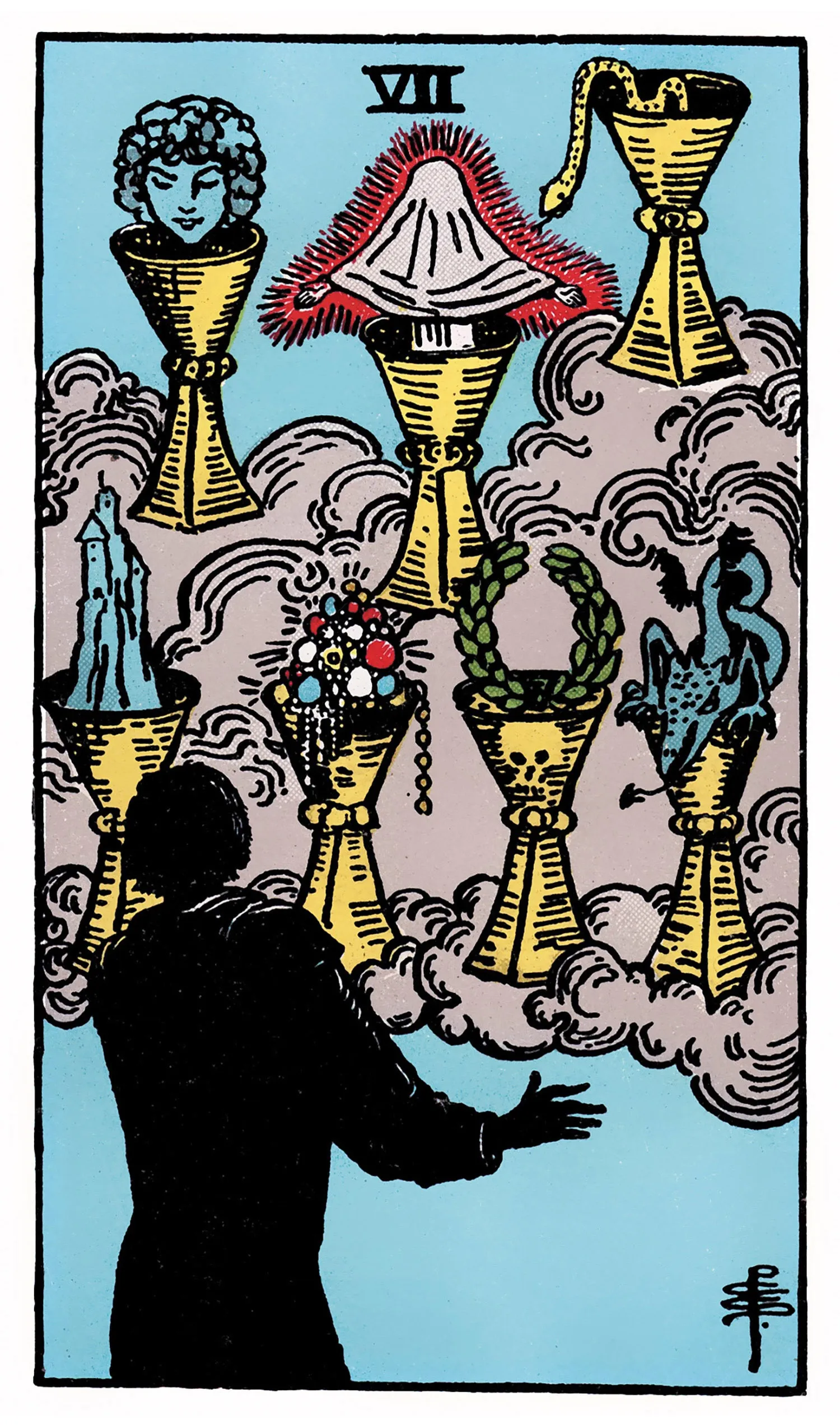
Minor Arcana · Cups · Seven
The Seven of Cups Tarot Card Meaning
The Seven of Cups represents a difficult process of emotional choice, imagination, possibility, and uncertainty.
After the relative harmony of the Six, the Seven becomes uncomfortable again. New possibilities open, desires multiply, and the person must determine what they actually want and which direction deserves their energy.
The Seven is not a final result. It is a path.
Depending on its position in a spread, the card can describe either a real field of possibilities that still needs to be explored or a distorted perception of the situation in which the querent imagines opportunities, results, resources, or future developments very differently from how they actually exist.
Card Meanings
General Meaning
The Seven of Cups appears when several possibilities compete for the person's emotional attention.
They may see:
- several choices;
- several people;
- several possible futures;
- several desires;
- several plans;
- several opportunities.
The difficulty is not simply deciding which option is logically superior.
This is Cups.
The person is emotionally responding to each possibility.
They may think:
“I want this.”
Then:
“Maybe I actually want that.”
And then:
“What if something better exists?”
The mind and emotions begin moving between different possible realities.
The Seven Principle
Within TAROVERA, all Sevens represent a process, path, movement, and navigation rather than a completed result.
After the comfort and restored balance of the Six, the Seven pushes the person into uncertainty again.
The Seven carries an echo of The Chariot:
- movement;
- direction;
- navigating competing impulses;
- choosing a path;
- remaining in motion;
- learning to control where energy goes.
The critical distinction is:
Seven describes the journey — not arrival.
This is especially important in Outcome questions.
A Seven may show that the person reaches another stage of the process, but not necessarily the final result.
Positional Logic — Real Options or Illusion?
The Seven of Cups must be interpreted in relation to its position in the spread.
This is one of the most important TAROVERA distinctions for the card.
In a Process Position
If the Seven of Cups appears in:
- development;
- how the situation unfolds;
- what happens next;
- process;
- intermediate stage;
it can describe genuine multiple possibilities.
There may actually be:
- several offers;
- several directions;
- several people;
- several solutions;
- several paths that could still develop.
The person is moving through a real field of options and has not yet chosen.
Here the card says:
“There are possibilities. You are still exploring them.”
In a Key Diagnostic Position
If the Seven of Cups appears as:
- the core of the situation;
- the reality of what is happening;
- the querent's understanding;
- the nature of the opportunity;
- a key answer about the situation;
the emphasis can shift strongly toward illusion and distorted perception.
The querent may:
- misunderstand what is actually happening;
- underestimate how many resources implementation will require;
- imagine a result that the situation does not realistically support;
- overestimate another person's intentions;
- misunderstand the scale of difficulty;
- interpret possibility as probability;
- treat imagination as evidence.
Here the card can say:
“What you think this situation is may not be what it actually is.”
The reality may develop very differently from the picture already formed in the querent's mind.
Possibility Is Not Reality
The Seven of Cups can create a vivid internal picture of success.
A person may see the result almost as clearly as if it already existed.
But:
being able to imagine a result is not the same as being close to achieving it.
The card often separates:
- potential from realization;
- desire from evidence;
- possibility from probability;
- image from substance.
This distinction is essential in:
- business;
- money;
- relationships;
- future predictions.
The person may already be emotionally living inside a future that has not actually been built.
Not Every Visible Option Is the Right One
Another important Seven of Cups meaning is that the correct answer may not necessarily be one of the obvious options currently being considered.
A person may believe:
“I have to choose A, B, or C.”
But the real solution may be:
- D;
- waiting;
- changing the question;
- creating another option;
- refusing all current options.
The card can therefore indicate that the person's field of choice itself is incomplete.
Sometimes the problem is not:
“Which cup should I choose?”
but:
“Why do I assume I have to choose one of these cups at all?”
Emotional Choice
Because Cups belong to Water, the Seven cannot be solved only by logic.
The person also needs to feel:
“Which of these possibilities is genuinely mine?”
But this is precisely where difficulty begins.
Desire can imitate intuition.
A person may strongly want something because it is:
- exciting;
- beautiful;
- flattering;
- forbidden;
- prestigious;
- emotionally stimulating.
That does not automatically make it correct.
The Seven therefore requires the person to distinguish:
intuition
from
wishful thinking.
What Would Actually Make You Happy?
The Seven of Cups raises a deeper question than:
“What do you want?”
It asks:
“If you actually receive what you want, will it produce the emotional experience you believe it will?”
A person may imagine that happiness depends on:
- a particular partner;
- more money;
- recognition;
- status;
- freedom;
- a specific lifestyle;
- one ideal future.
But sometimes the desire is only a symbol for another unmet emotional need.
The card may reveal that a person knows very clearly what they want to obtain, but not yet why they want it.
Imagination as a Resource
Imagination is not automatically negative in the Seven of Cups.
Upright, it can be one of the card's greatest strengths.
The mind temporarily moves beyond existing limitations and asks:
- What else could exist?
- What if I tried another direction?
- What have I never considered before?
- What kind of life would actually interest me?
This makes the Seven especially useful for:
- creativity;
- brainstorming;
- visual thinking;
- artistic work;
- exploring possibilities;
- searching for meaning;
- expanding the worldview.
Some ideas may be completely unrealistic.
Others may become important later.
At this stage, imagination is exploring territory before reality has been built there.
Temptation Along the Path
Because Seven represents a path, the cups can also function as temptations along the journey.
The person may begin with one direction but become distracted by:
- pleasure;
- admiration;
- money;
- status;
- romance;
- excitement;
- another attractive opportunity.
The risk is not simply choosing badly.
The person may become so fascinated by all the possibilities encountered along the way that they forget where they were originally going.
Desire as the Problem
The Seven of Cups can show a situation where the person's own desires create the confusion.
They may want:
- everything;
- incompatible things;
- contradictory outcomes.
For example:
“I want complete freedom, complete security, total commitment, no responsibility, excitement, and perfect stability.”
Each desire may make sense separately.
Together they may be impossible.
The Seven therefore asks:
“Which desire matters enough that you are willing to give up the others?”
The Shadow Side of The Seven of Cups
The shadow begins when imagination stops expanding reality and starts replacing it.
The person may:
- fantasize instead of acting;
- endlessly compare;
- refuse to choose;
- wait for perfection;
- become addicted to possibility;
- confuse desire with truth;
- believe promises too easily;
- create detailed futures unsupported by facts.
Another important shadow is talent without discipline.
The Seven can give:
- imagination;
- artistic talent;
- creative vision;
- ideas.
But the person may enjoy imagining themselves successful more than doing the work required to develop the talent.
They may love the identity:
“I could be very good at this.”
without accepting:
“I need years of consistent work to become good at this.”
Potential remains potential.
The card can also show escapism through:
- alcohol;
- substances;
- entertainment;
- fantasy;
- pleasure;
- altered states.
Reality feels demanding, so the person creates another place to live mentally or emotionally.
The Seven of Cups Reversed
The reversed Seven of Cups worsens the difficulty of the upright card.
The person becomes more confused, less practical, and less able to distinguish between:
- desire;
- fear;
- imagination;
- intuition;
- reality.
Possible manifestations include:
- tangled thinking;
- impracticality;
- illusion;
- self-deception;
- escapism;
- inability to prioritize;
- indecision;
- inner conflict;
- suspicion;
- broken promises;
- unreliable behavior;
- altered states through substance use.
The upright card may still be exploring.
The reversed card may already be lost inside the exploration.
The Wrong Choice Has Already Been Made
The reversed Seven can also indicate that confusion has already produced consequences.
The person may have:
- selected the wrong option;
- believed an unrealistic promise;
- entered the wrong relationship;
- made a financially impractical decision;
- committed to something without understanding the real cost.
Now the problem is no longer simply:
“Which option should I choose?”
It becomes:
“What do I do with the consequences of the choice I already made?”
This is an important reversed Seven of Cups mechanism.
The Rose-Colored Glasses Come Off
The broader TAROVERA reversed-Cups principle applies strongly here:
the rose-colored glasses come off.
But this is not automatically a positive moment of perfect clarity.
The realization may hurt.
The person may discover:
“The future I imagined was never actually available in that form.”
Or:
“I misunderstood what I was being offered.”
Or:
“I did not understand what this would really cost me.”
The illusion breaks, but consequences may already exist.
Core Message
The Seven of Cups opens a field of possibility.
Sometimes the options are real.
Sometimes the person's perception of them is not.
The task is not simply to choose what looks most attractive.
It is to determine:
what actually exists, what you genuinely want, and which possibility can survive contact with reality.
The Seven of Cups as a Person
The Seven of Cups as a person describes someone imaginative, creative, emotionally responsive, and capable of seeing many possibilities.
They may have:
- rich imagination;
- strong visual thinking;
- creative talent;
- many interests;
- emotional sensitivity;
- a vivid inner world;
- an ability to think beyond conventional limits.
They may be excellent at generating ideas.
They can imagine solutions others do not see.
This can make them:
- artistic;
- inventive;
- visionary;
- conceptually strong.
However, focus may be difficult.
Every new possibility creates another emotional pull.
The person may frequently change:
- plans;
- ambitions;
- preferences;
- goals.
They may also overestimate talent if they confuse potential with mastery.
At their best:
they imagine possibilities and then choose one to develop.
At their worst:
they remain permanently fascinated with what they could become.
The Seven of Cups as Actions
As Actions, the Seven of Cups often remains in the exploratory phase.
The person may:
- compare options;
- research possibilities;
- imagine outcomes;
- brainstorm;
- look at several alternatives;
- hesitate;
- postpone the final decision;
- begin several things;
- change direction.
In a process position, this can be completely appropriate.
The person is still exploring.
Sometimes the action is simply:
“I am not ready to choose yet.”
The Seven of Cups in Love and Relationships
The Seven of Cups brings possibility, imagination, projection, and uncertainty into relationships.
It can indicate:
- several potential partners;
- several admirers;
- attraction to more than one person;
- online romantic possibilities;
- uncertainty about what kind of relationship is wanted;
- fantasy;
- idealization;
- temptation.
In a process position, it may literally mean:
the person is still choosing between real romantic possibilities.
In a key diagnostic position, it may instead say:
the querent's understanding of the relationship is heavily idealized or incomplete.
Falling in Love With an Image
One of the strongest Seven of Cups love meanings is projection.
A real person exists.
But imagination adds:
- commitment;
- intentions;
- emotional depth;
- future plans;
- compatibility;
- personality traits.
The querent may love:
who the person could be
more than:
who the person has actually demonstrated themselves to be.
This does not make the emotional experience unreal.
The feelings can be very strong.
The problem is that part of the relationship exists mainly inside imagination.
Desire, Sensuality, and Temptation
The Seven of Cups can also show strong sensual or romantic temptation.
The person may become fascinated by:
- attraction;
- fantasy;
- sexual possibility;
- emotional intoxication;
- being desired;
- the excitement of choice itself.
This can create attachment not only to a person but to the emotional high of imagining possibilities.
The card should not automatically be interpreted as extreme sexuality, but sensual fantasy and temptation can be important contextual meanings.
The Seven of Cups as Thoughts
The person thinks in scenarios.
They may ask:
- “What if I choose this person?”
- “Maybe someone better will appear.”
- “What if this becomes serious?”
- “What if I am wrong?”
- “What do I actually want?”
- “What if the relationship becomes exactly what I hope?”
They may mentally move the relationship much further ahead than reality has moved.
In a diagnostic position, Thoughts can show that assumptions have begun replacing facts.
The Seven of Cups as Feelings
The Seven of Cups can indicate strong fascination.
Possible feelings include:
- infatuation;
- attraction;
- curiosity;
- romantic excitement;
- longing;
- idealization;
- sensual desire.
But it is not automatically mature love.
The person may be emotionally attached to:
the experience they imagine the relationship could create.
Therefore the feelings can be subjectively intense but unstable.
The Seven of Cups as Intentions
Intentions are often unclear because the person may want several incompatible things simultaneously.
They may want:
- commitment and freedom;
- intimacy without responsibility;
- one partner while keeping other options;
- a relationship only if it matches an ideal fantasy.
They may genuinely mean a promise when they make it.
But their desire can later change.
The Seven of Cups as an Outcome
The Seven of Cups is not a strong card of final realization.
This is critical.
Seven describes a process.
As an Outcome, the situation may reach:
- multiple possibilities;
- uncertainty;
- deliberation;
- an important choice;
- discovery of new options;
- a stage where reality still has not fully taken shape.
The result may therefore be:
“You will arrive at a point where you must choose.”
rather than:
“You will receive the thing you want.”
Outcome Depends Strongly on Position and Question
If the Seven is the natural endpoint of a process-oriented question, it may mean:
several real possibilities remain open.
But if the question asks:
“Will this exact imagined scenario happen?”
the Seven is much less reassuring.
It may show that the querent's expected result is:
- idealized;
- misunderstood;
- incomplete;
- not yet supported by reality.
The person may believe they are approaching one result when the situation is actually far more uncertain.
The Seven of Cups in Career and Work
In Career, the Seven of Cups is especially strong during the exploration stage.
It can indicate:
- several vacancies;
- several business ideas;
- several professional directions;
- brainstorming;
- creative planning;
- researching a career change;
- multiple proposals;
- several possible projects.
In a process position, these may be real opportunities.
The task is to evaluate and choose.
When Career Is Being Diagnosed
In a key position describing the actual professional situation, the card may become much more cautionary.
It can show:
- unrealistic expectations;
- overestimating a project;
- misunderstanding workload;
- underestimating resources required;
- expecting returns unsupported by evidence;
- believing a beautiful presentation more than the actual conditions.
A business idea may look far more profitable in imagination than in execution.
The Situation May Not Be Ready Yet
Sometimes the Seven does not mean:
“The idea is bad.”
It means:
“The idea has not matured enough for implementation.”
The concept may still require:
- research;
- testing;
- resources;
- structure;
- prioritization;
- a clearer plan.
This fits the Seven principle perfectly.
The person is still on the path between possibility and material realization.
Creativity vs Work
The Seven can give strong creative potential.
But talent does not automatically become professional skill.
The person may imagine:
- the successful project;
- the future career;
- the recognition;
- the completed product;
without doing enough repetitive practical work.
The card asks whether imagination is being converted into discipline.
Support After a Clear Choice
Another possible career mechanic:
while the person says:
“I don't know what I want,”
other people may not know how to help.
Once a clear intention appears, practical support can become easier to access.
This does not guarantee success.
It simply means that a defined direction makes cooperation possible.
The Seven of Cups in Money and Finances
The Seven of Cups is not a strong card of money already received.
It represents:
- financial possibilities;
- expectations;
- imagined profits;
- several earning ideas;
- attractive offers;
- financial temptation.
One of the most important rules is:
do not count projected income as money already earned.
The person may calculate:
“If this sells, I make this much. Then I launch that, and I make even more.”
But all of it remains hypothetical until actual realization.
Diagnostic Financial Meaning
In a key financial position, Seven of Cups can indicate that the person's financial expectations are distorted.
They may:
- underestimate costs;
- overestimate demand;
- believe projected profit;
- fail to account for risk;
- misunderstand how much capital or labor implementation requires.
The numbers may look wonderful because they are being built from assumptions.
Attractive or Deceptive Offers
The card can also warn of:
- misleading financial proposals;
- deceptive advertising;
- scams;
- shadow deals;
- offers that look far better than they actually are.
This is not automatic fraud.
The broader warning is:
verify substance behind presentation.
The Seven of Cups in Health
Within the TAROVERA health correspondence system, the upright Seven of Cups is associated with:
- poisoning;
- overdose;
- developing dependence on recreational substances;
- hallucination-like or altered states.
The internal system also associates the card with:
- the bladder;
- the genitourinary system;
- cystitis;
- urinary incontinence.
The Seven of Cups Timing — When Will It Happen?
The Seven of Cups does not provide a reliable calendar timeframe.
When asked:
“When will this happen?”
the card often challenges the assumption behind the question itself.
The person may currently be imagining realization rather than observing actual development.
Key Timing Correspondence
No reliable fixed timeframe.
The Seven of Cups can indicate:
- illusion of realization;
- mistaken expectations;
- misunderstanding of whether the event is actually developing;
- a future imagined more clearly than it is being created.
The correct follow-up question may therefore be:
“Is this event actually moving toward realization in reality?”
rather than:
“Exactly when will it happen?”
The Seven of Cups as an Event
As an Event, the Seven of Cups can bring:
- several offers;
- multiple alternatives;
- a difficult choice;
- several romantic candidates;
- several possible directions;
- creative exploration;
- a highly tempting opportunity;
- a moment when a decision becomes necessary.
In a process-oriented situation, these possibilities may be real.
The event can literally be:
the field of options expands.
But the card can also describe a misleading or highly subjective event:
something appears much more promising than it actually is.
The Seven of Cups as Card of the Day
The Seven of Cups can bring a day full of ideas, choices, desires, and distractions.
You may find yourself thinking:
- “Maybe this.”
- “Maybe that.”
- “What if I choose something completely different?”
This can be productive for:
- brainstorming;
- creative work;
- research;
- exploring options;
- imagining alternatives.
It is weaker for irreversible decisions made without verification.
Today, pay particular attention to the difference between:
what exists
and
what you assume exists.
The Seven of Cups as Advice
Allow yourself to explore.
The Seven of Cups does not always demand an immediate decision.
Sometimes the current task is to widen the field and discover possibilities that previously could not be seen.
Ask:
- What do I actually want?
- Why do I want it?
- What would truly make me happy?
- Which options really exist?
- Which options have I emotionally invented?
- What resources would realization actually require?
- Which possibility would I still want if the fantasy surrounding it disappeared?
Do not choose exclusively through logic.
Your emotional response matters.
But intuition must be tested against reality.
Consider the Possibility That None of the Current Options Is Right
Do not assume that one of the visible cups must contain the answer.
The best option may be:
- another path;
- another person;
- another project;
- waiting;
- refusing the available choices.
Expand the question before forcing the answer.
Choose a Direction Eventually
Exploration has value.
Permanent exploration does not.
At some point, the person must decide which possibility deserves actual:
- time;
- energy;
- money;
- commitment.
Until that happens, everything remains potential.
The Seven of Cups Reversed as Advice
Stop feeding possibilities that have no realistic foundation.
Separate:
- facts from assumptions;
- promises from imagined promises;
- intuition from anxiety;
- desire from evidence.
If a wrong decision has already been made, stop trying to preserve the original fantasy.
Assess the real consequences and respond to what actually exists now.
Do not escape into:
- substances;
- entertainment;
- fantasy;
- endless planning;
to avoid the decision reality requires.
The Seven of Cups as a Warning
Do not confuse:
possibility with result.
Do not confuse:
desire with evidence.
Do not confuse:
a vivid internal picture with actual progress.
The Seven warns against:
- idealization;
- false promises;
- manipulative presentation;
- unrealistic advertising;
- temptation;
- fantasy replacing action;
- keeping too many options open;
- wanting incompatible things;
- refusing to prioritize.
Do Not Lose the Path Among the Temptations
The Seven carries the path principle of The Chariot.
Every attractive cup can become a distraction.
If every new possibility makes you abandon the previous direction, you may spend years moving without actually going anywhere.
Ask:
“Is this a new opportunity — or simply another distraction from the path I already chose?”
Potential Is Not Achievement
Talent is not mastery.
An idea is not a business.
Attraction is not a relationship.
Projected profit is not money.
A beautiful future is not evidence that the future will happen.
The Seven of Cups — Yes or No
Upright: It May Seem Like Yes, but It Will Not Happen as Planned
It may seem like yes — but it is unlikely to happen the way you imagine.
The Seven of Cups can create a very convincing picture of realization.
There may appear to be:
- promising options;
- attractive signs;
- several opportunities;
- a desirable future.
But the card does not confirm that the querent understands the situation correctly.
They may be mistaken about:
- how realization will occur;
- the resources required;
- another person's intentions;
- the probability of success;
- the final form of the result.
So the answer is not a clean yes.
It is:
“You may currently believe the answer is yes, but reality is likely to look different from what you have imagined.”
Reversed: No
No.
The reversed Seven of Cups strengthens:
- illusion;
- poor judgment;
- impracticality;
- confusion;
- self-deception;
- failure to prioritize;
- consequences of a wrong choice.
The desired scenario is unlikely to materialize properly.
The Seven of Cups Symbolism
The Rider–Waite–Smith Seven of Cups shows a figure facing seven cups suspended inside a cloud.
Each cup contains a different image.
The card visually represents possibility before commitment — and the difficulty of distinguishing what could become real from what exists mainly in imagination.
The Seven Cups
The seven cups represent:
- desires;
- choices;
- possibilities;
- temptations;
- imagined futures.
The person does not face one clear answer.
They face many.
That creates freedom.
It also creates confusion.
The Cloud
The cups do not stand on solid ground.
They float in a cloud.
This is crucial.
The possibilities have not yet fully entered material reality.
Some may eventually become real.
Some may never become more than imagination.
The cloud therefore represents:
potential without established form.
The Different Images
Each cup contains something different.
This reflects the diversity of human desire.
A person may want:
- love;
- money;
- recognition;
- mystery;
- status;
- security;
- pleasure.
The card does not automatically condemn the desires.
It asks:
which desire actually belongs to your path?
The Tempting Images
The cups can also be viewed as temptations encountered along the Seven's journey.
Each promises a different reward.
The risk is that the traveler becomes so fascinated by the possibilities that they forget the destination.
The Hidden and Unclear Images
Some images are difficult to interpret clearly.
This reflects incomplete information.
The person may be choosing while still not knowing everything about the available options.
The Seven therefore warns against believing that appearance equals understanding.
The Figure Facing the Cups
The figure stands before the cups.
They do not possess them.
This visually confirms:
consideration is not realization.
The person is still:
- imagining;
- evaluating;
- deciding.
Nothing has yet become firmly established.
The Number Seven
Within TAROVERA, Seven represents:
- path;
- process;
- movement;
- searching;
- navigation;
- choosing direction.
It carries an echo of The Chariot.
But the Seven does not indicate arrival.
It describes being somewhere between departure and destination.
For Cups, this path is navigated through:
- desire;
- imagination;
- emotional preference;
- intuition.
The Core Symbolism of The Seven of Cups
The Seven of Cups is the image of possibility before commitment.
Many futures can be imagined.
Some options may genuinely exist.
Others may exist mainly because the querent has emotionally constructed them.
The spread position becomes crucial.
In a process position:
the card may describe real exploration and real choice.
In a key diagnostic position:
the card may warn that the querent's picture of reality is significantly distorted.
The deepest questions are therefore:
“What actually exists?”
“What have I added through imagination?”
“What do I truly want?”
“Would obtaining it actually make me happy?”
and finally:
“Which possibility is real enough that I am willing to stop imagining and start choosing?”