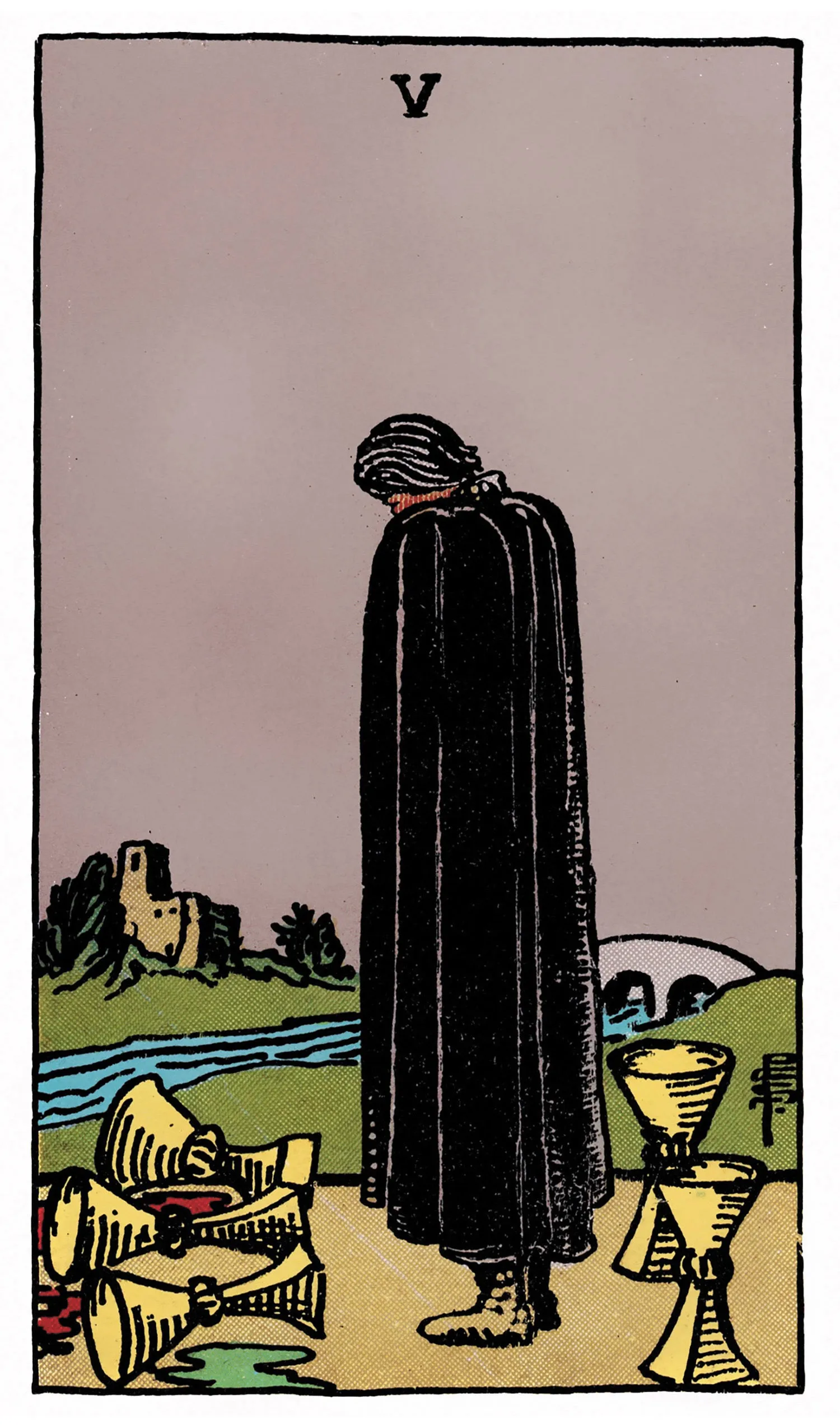
Minor Arcana · Cups · Five
The Five of Cups Tarot Card Meaning
The Five of Cups represents the breaking of emotional equilibrium. Something that was previously stable, familiar, or at least tolerable can no longer continue in the same way.
Like all Fives in TAROVERA, this card pushes the person beyond an established limit. Stability gives way to movement, pressure, conflict, difficult choices, and transformation.
In the suit of Cups, this disruption happens through feelings, relationships, family, hopes, attachment, and emotional security.
The experience is uncomfortable by nature. But the Five does not destroy stability without purpose: the old structure is being disturbed because something within it can no longer remain unchanged.
Card Meanings
General Meaning
The Five of Cups begins where the stability of the Four can no longer hold.
Four creates structure.
Five breaks the equilibrium and forces movement.
This movement may not be wanted. It usually consumes energy, creates tension, and pushes the person outside their comfort zone.
Within the Cups suit, the result is emotional disturbance.
The card can indicate:
- disappointment;
- separation;
- family conflict;
- emotional distress;
- anxiety;
- painful realizations;
- unexpected situations at home;
- changed plans;
- broken expectations;
- loss;
- emotional instability;
- strong resentment;
- a situation that can no longer be tolerated as before.
A very typical Five of Cups scenario is:
people lived together, tolerated problems for a long time, maintained the familiar structure — and then one conflict finally broke the old balance.
What had been suppressed becomes impossible to ignore.
The Five can therefore mark:
- a serious argument;
- leaving;
- separation;
- a family crisis;
- changed living arrangements;
- a painful decision;
- a sudden change in the emotional environment.
The card is unpleasant because movement occurs under pressure.
But movement still occurs.
The Five Principle
Within TAROVERA, all Fives represent:
- disruption of previous equilibrium;
- movement after stability;
- pressure;
- difficulty;
- transformation;
- choice;
- responsibility;
- leaving the familiar;
- entering an uncertain new cycle.
They are connected with the principle of the Hierophant:
- tradition;
- morality;
- social and family rules;
- inherited beliefs;
- established norms;
- responsibility for one's choices.
This makes the Five of Cups especially relevant when emotional pain is connected with family expectations, inherited relationship patterns, moral conflict, or the feeling that a person has violated something they themselves believed was right.
Within the TAROVERA system, Fives also carry the theme of ancestral karma.
Family patterns, inherited emotional behaviors, unresolved conflicts, and negative experiences passed through generations may become situations that require conscious transformation in the person's own life.
The lesson may repeat until the person responds differently.
Acquisition Through Loss
One of the most important Five of Cups meanings is:
acquisition through loss.
Something may have to disappear, break, or change before another path becomes possible.
Examples:
- a relationship ends and personal freedom returns;
- family conflict forces healthy boundaries;
- disappointment destroys an illusion;
- a failed plan reveals another direction;
- losing one connection exposes who is genuinely supportive;
- emotional pain forces the person to rethink what they truly value.
The gain does not make the loss pleasant.
The loss is still real.
But the Five often removes something that could not remain unchanged if development was to continue.
Emotional Maximalism
The Five of Cups does not always manifest quietly.
It can produce extremely strong emotional reactions:
- anger;
- resentment;
- indignation;
- dramatic decisions;
- emotional outbursts;
- all-or-nothing thinking.
The person may react as though:
“If it cannot be exactly the way I wanted, then I want none of it.”
This is one reason the Five can create more destruction than the original problem required.
Pain becomes amplified by emotional extremity.
The Shadow Side of The Five of Cups
The shadow appears when the person begins reinforcing their own disappointment.
The central internal mechanism is perception.
The same situation may contain:
- loss;
- remaining resources;
- painful truth;
- new possibilities;
- people who left;
- people who stayed.
But the person may consciously or unconsciously choose to see only the worst.
They may:
- dramatize;
- repeatedly replay the loss;
- blame themselves;
- blame another person;
- cultivate resentment;
- ignore support;
- refuse to acknowledge what remains;
- idealize what was lost;
- treat the entire situation as ruined because one part failed.
A particularly destructive pattern is:
hurting yourself in order to punish someone else.
The person may unconsciously think:
“If I remain miserable, you will understand what you did to me.”
But the result is that the original loss continues damaging them long after the event itself.
Another shadow arises when the person has acted against their own values.
They may have:
- accepted a relationship they knew was wrong for them;
- tolerated behavior they considered unacceptable;
- betrayed their own moral boundaries;
- chosen something contrary to their own beliefs.
Then the disappointment is not only:
“You hurt me.”
It is also:
“I knew better, and I still participated in this.”
This can create deep regret and disappointment in oneself.
The Five of Cups Reversed
The reversed Five of Cups shows an impaired ability to pass through the necessary Five-stage transformation.
The upright card says:
the old emotional balance has been broken and painful change is necessary.
The reversed card says:
the person cannot decide how to move through that change.
They may become:
- indecisive;
- emotionally dependent;
- uncertain;
- afraid of their own choices;
- hesitant;
- psychologically stuck between staying and leaving.
This can manifest as:
- continuing a destructive relationship;
- leaving and returning repeatedly;
- making empty plans;
- changing decisions constantly;
- avoiding an important conversation;
- being unable to trust one's own judgment;
- disappointment in a choice already made;
- unpleasant surprises;
- emotional suppression.
The person may understand that the old situation is unhealthy and still refuse to let it end.
The broader reversed-Cups principle also applies:
the rose-colored glasses come off.
Here, the realization may be:
what I hoped to repair, restore, or return to its former state cannot actually become what it was.
But instead of accepting this and moving through the transformation, the person remains suspended between past and future.
The reversed Five of Cups is therefore not automatically recovery, reconciliation, or emotional renewal.
It is a worsening of the upright principle through uncertainty, dependency, and failure to complete the necessary emotional transition.
Core Message
Something has been lost, damaged, or emotionally disrupted.
That part is real.
But your interpretation of the loss determines whether the Five becomes only suffering or the beginning of transformation.
You cannot control every painful event.
You can control whether you continue feeding the part of the story that has already hurt you.
The Five of Cups as a Person
The Five of Cups as a person describes someone emotionally intense, sensitive, and strongly affected by disappointment.
They may remember emotional injuries for a long time.
They do not easily forget:
- betrayal;
- rejection;
- abandonment;
- family conflict;
- humiliation;
- their own mistakes.
This person may have strong emotional depth and an instinctive understanding of other people's pain.
Difficult experiences can broaden their worldview, deepen creativity, and give them insight that could not have developed inside an entirely comfortable life.
However, their mood strongly influences perception.
The same situation can seem manageable on one day and catastrophic on another.
They may be prone to:
- dramatization;
- emotional maximalism;
- strong resentment;
- anger;
- all-or-nothing reactions.
At their best, they transform pain into wisdom.
At their worst, they become identified with their disappointment.
The Five of Cups as Actions
As Actions, the Five of Cups reacts to emotional disruption.
The person may:
- leave;
- withdraw;
- cry;
- argue;
- confront;
- change plans;
- end contact;
- move away;
- stop attending family or social situations;
- attempt to recover something lost.
It may also show a change of environment motivated by the desire to escape a painful issue.
For example, someone may leave a family home or move away from relatives because continuing to face the same unresolved conflict has become intolerable.
The action can be impulsive because the emotional pressure is strong.
The Five of Cups in Love and Relationships
The Five of Cups is difficult in romantic questions because the previous emotional equilibrium has already been damaged.
It can indicate:
- separation;
- serious conflict;
- family problems;
- disappointment in a partner;
- broken expectations;
- regret;
- emotional pain;
- change in living arrangements;
- a relationship continuing after something important has been damaged.
A typical scenario is:
the couple tolerated problems for a long time, and then one conflict finally broke through the accumulated tension.
The relationship may survive.
But the previous emotional structure cannot simply be restored by pretending nothing happened.
The card can also show:
- resentment after betrayal;
- deep disappointment;
- regret over how someone behaved;
- regret over staying too long;
- regret over leaving;
- the realization that the relationship violated one's own values.
This last point is especially important.
Sometimes the person is not only disappointed in their partner.
They are disappointed in themselves because they accepted something they previously believed they would never accept.
The Five of Cups can therefore expose a conflict between:
love / attachment
and
personal values / morality / self-respect.
In some contexts, the card can accompany marriage or continuation of a formal relationship.
However, the existence of the union does not guarantee happiness.
The person's emotional attitude toward what exists remains decisive.
The Five of Cups as Thoughts
The Five of Cups is strongly retrospective.
The person may think:
- “Why did this happen?”
- “What did I do wrong?”
- “Could I have prevented it?”
- “Why did they do this to me?”
- “Everything could have been different.”
- “I should never have agreed to this.”
- “Why did I ignore what I already knew?”
They may find it difficult to force themselves to think about the actual important question:
“What do I do now?”
Instead, the mind circles around the past.
The Five of Cups as Feelings
The Five of Cups is emotionally strong.
This is not indifference.
The feelings may include:
- sadness;
- grief;
- disappointment;
- resentment;
- anger;
- longing;
- regret;
- anxiety;
- hurt.
In a romantic question, the person may still be deeply emotionally involved.
The problem is that they experience the connection through pain.
They can:
- love and resent simultaneously;
- miss someone and still feel betrayed;
- want the relationship and believe it is destroying them;
- feel intensely but no longer trust the connection.
The Five of Cups as Intentions
As Intentions, the Five of Cups does not show a calm or confident plan.
The person may want to:
- leave;
- withdraw;
- change the situation;
- receive an explanation;
- demand an apology;
- apologize;
- recover what was lost;
- distance themselves;
- escape a painful environment.
But strong feelings often interfere with clear strategy.
The Five of Cups as an Outcome
As an Outcome, the Five of Cups is emotionally unfavorable.
The result can bring:
- disappointment;
- loss;
- changed plans;
- regret;
- emotional distress;
- conflict;
- a painful realization.
The previous equilibrium is broken.
However, the Five does not automatically mean total destruction.
A central outcome mechanic is:
acquisition through loss.
Something may be lost precisely because another stage of development has become necessary.
The result may therefore contain two truths at once:
something went wrong
and
something still remains.
The person's perception becomes crucial.
If they see only the failure, they may remain stuck inside it.
If they acknowledge the loss while also seeing what remains, the same difficult outcome can become the beginning of another cycle.
The two remaining cups may represent not only abstract opportunities but also real people who remain loyal and supportive.
Someone may be grieving the person who left while failing to see the partner, friend, family member, or ally who is still standing beside them.
The Five of Cups in Career and Work
In Career, the Five of Cups indicates professional disappointment and disruption.
Possible manifestations include:
- a failed project;
- rejection;
- loss of a position;
- a disappointing result;
- professional conflict;
- changed plans;
- regret about a decision;
- leaving an emotionally intolerable workplace;
- a failed agreement;
- broken promises;
- a contract or arrangement that does not develop as expected;
- failure in an exam, selection process, audition, or competition;
- talents being overlooked or insufficiently recognized.
The person may focus so intensely on one failure that they temporarily stop seeing remaining professional options.
The Five does not automatically mean total career collapse.
It can describe a painful transition that forces the person to reconsider:
- direction;
- ambitions;
- environment;
- expectations;
- professional values.
The card may also indicate the urge to run away from the problem instead of addressing it directly.
Changing jobs or environments can be useful, but only if the underlying issue does not simply follow the person into the next situation.
The Five of Cups in Money and Finances
Financially, the Five of Cups can indicate real loss or disappointment.
Possible manifestations include:
- temporary financial losses;
- unexpected expenses;
- receiving less money than expected;
- profit below expectations;
- a disappointing financial result;
- regretting an investment;
- regretting a purchase;
- a financial plan changing unexpectedly;
- money connected with a broader loss or family problem.
However, the Five of Cups remains an emotional card.
The emotional reaction may sometimes be greater than the objective financial damage.
It is therefore important to distinguish:
what was actually lost
from
how catastrophic the person feels the loss is.
The card can also show acquisition through loss financially.
Leaving one arrangement, accepting a temporary loss, or abandoning an unproductive plan may eventually make another option possible.
The Five of Cups in Health
In the TAROVERA health system, the upright Five of Cups is associated with nervous breakdowns and emotionally stressful states.
The internal correspondence system also includes:
- removal of abscesses or boils;
- benign formations;
- the adrenal glands.
The Five of Cups Timing — When Will It Happen?
The Five of Cups indicates slow development accompanied by a painful delay.
The process rarely feels smooth.
Emotional complications, changes of plans, indecision, conflict, or difficult circumstances can make the waiting period feel especially long.
Key Timing Correspondence
Approximately two to three months.
The event develops slowly, and the delay itself may become part of the emotional difficulty represented by the card.
The Five of Cups as an Event
As an Event, the Five of Cups represents something that disrupts the previous emotional balance.
Possible manifestations include:
- separation;
- serious argument;
- upsetting news;
- changed family circumstances;
- disappointment;
- change of plans;
- emotional conflict;
- moving out;
- cancellation of something important;
- a failed agreement;
- an unpleasant surprise;
- a situation that forces an uncomfortable choice.
It can also show a change of surroundings caused by a desire to avoid an acute emotional issue.
For example, someone may leave a family environment because they can no longer tolerate the same conflict.
The event is unpleasant.
But it pushes the situation into movement.
The Five of Cups as Card of the Day
The Five of Cups can make the day emotionally heavier than expected.
Plans may change.
A conversation may disappoint.
A family issue may surface.
Something may remind you of a previous loss or unresolved emotional problem.
You may also react more strongly than the objective event appears to justify.
The important question is:
What actually happened — and what part of your reaction comes from everything this event reminds you of?
The day can also reveal who remains beside you when something goes wrong.
The Five of Cups as Advice
The Five of Cups does not advise pretending everything is fine.
And it does not tell you to immediately stop feeling pain.
Some losses must first be acknowledged and emotionally lived through.
Do not try to skip the grief simply because you know intellectually that “something still remains.”
First:
recognize what was lost.
Allow yourself to understand:
- what hurt;
- why it mattered;
- what expectation was broken;
- what can no longer continue in its old form.
Only then look at:
- what remains;
- who remains;
- what can still be saved;
- what must now change.
The Five of Cups can also advise an intentional sacrifice in order to restore harmony.
Something may need to be released:
- an old expectation;
- a destructive relationship;
- a family role;
- a familiar environment;
- a belief inherited from others;
- the desire to preserve the past exactly as it was.
The sacrifice is uncomfortable.
But refusing it may prolong the crisis.
The Five of Cups Reversed as Advice
Stop postponing the decision simply because every available option is uncomfortable.
If a relationship or situation repeatedly destroys your emotional balance, remaining inside it is also a choice.
Do not make empty plans merely to avoid confronting what must actually change.
And do not confuse returning to a familiar pain with repairing the situation.
The Five of Cups as a Warning
Do not turn disappointment into a worldview.
The Five of Cups warns against:
- dramatizing every loss;
- all-or-nothing thinking;
- emotional maximalism;
- endless regret;
- replaying the past;
- blaming yourself indefinitely;
- blaming another person for every part of your suffering;
- refusing to see what remains;
- ignoring people who still support you;
- hurting yourself in order to punish someone else.
It also warns against acting against your own values and then blaming only the external situation for the consequences.
If you knew something violated your boundaries, beliefs, or moral principles, acknowledge your own participation honestly.
That is not the same as self-punishment.
It is responsibility.
The Hierophant connection of the Five asks:
Which values are truly yours, and are you actually living according to them?
The Five of Cups — Yes or No
Upright: Most Likely No
Most likely no.
The Five of Cups usually indicates disappointment, changed expectations, emotional loss, or a result that is painful to accept.
Something useful may still remain.
But the desired scenario itself is unlikely to unfold cleanly.
This is a “no” shaped by disappointment rather than complete absence of possibility.
Reversed: Most Likely No
Most likely no — with an even stronger risk of disappointment.
The reversed Five of Cups adds:
- indecision;
- emotional dependence;
- empty or failed plans;
- repeated mistakes;
- difficulty completing the necessary change.
The result may therefore be even further from what the person hoped for.
A Yes/No interpretation should not be used mechanically without considering the exact question, spread position, and surrounding cards.
The Five of Cups Symbolism
The Rider–Waite–Smith Five of Cups shows a cloaked figure looking toward three overturned cups while two upright cups remain behind them.
The image expresses the card's central question:
What does the person choose to see after something has gone wrong?
The Three Spilled Cups
The overturned cups represent real loss.
Something has been spilled.
The card does not deny that.
There may have been:
- emotional damage;
- disappointment;
- failure;
- separation;
- betrayal;
- change.
The person has a legitimate reason to grieve.
The Two Standing Cups
Two cups remain upright.
They do not cancel the three that were lost.
They represent what survives:
- emotional resources;
- opportunities;
- relationships;
- experience;
- support;
- another possible direction.
Importantly, these cups can sometimes represent specific people who remain beside the person.
Someone may be so focused on the person who left that they fail to see those who still love, support, or stand with them.
The Cloaked Figure
The dark cloak encloses the figure and reflects emotional immersion.
The person is so deeply inside the feeling that the wider situation becomes difficult to see.
This can represent:
- grief;
- withdrawal;
- emotional maximalism;
- self-pity;
- fixation on disappointment.
The River
The river represents movement and transition.
The old emotional state cannot remain fixed.
The Five forces change.
To reach another stage, the person eventually has to move rather than remain forever beside what has already been spilled.
The Bridge
The bridge represents the possibility of transition.
It does not promise that crossing will be easy.
It simply shows that the emotional crisis is not necessarily the final state.
This directly reflects the TAROVERA Five principle:
growth occurs under pressure and requires leaving the previous equilibrium behind.
The Building in the Distance
The distant structure suggests that stability exists beyond the immediate emotional crisis.
But the person cannot reach it while remaining completely absorbed in the spilled cups.
Another stable form becomes possible only after the disruptive Five-stage transition has been crossed.
The Number Five
Five breaks the stability of Four.
It represents:
- instability;
- movement;
- tension;
- challenge;
- transformation;
- choice;
- responsibility.
Within TAROVERA, Five is connected with the Hierophant principle:
- traditions;
- morality;
- inherited norms;
- family structures;
- ancestral patterns.
This means the crisis may force the person to decide:
Which inherited rules should remain, and which must be consciously transformed?
The Core Symbolism of The Five of Cups
The Five of Cups is the image of emotional equilibrium being broken.
The loss is real.
The pain is real.
The anger may also be real.
But the picture is larger than the loss.
Three cups have fallen.
Two remain.
Some people may have left.
Others may still be standing beside you.
A river must be crossed.
A bridge exists.
The old emotional structure cannot simply be restored exactly as it was.
The essential question is not:
“Did something go wrong?”
Something did.
The deeper questions are:
“What is truly lost?”
“What still remains?”
and
“Will you allow the loss to transform your life — or will you continue sacrificing what remains to what has already been spilled?”