Minor Arcana · Cups · Two
The Two of Cups Tarot Card Meaning
The Two of Cups represents a meeting between two sides that recognize, respond to, and choose one another. Where the Ace of Cups describes the birth of an emotional experience, the Two turns that feeling into exchange: one person reaches out and the other responds.
This is a card of mutual attraction, agreement, partnership, reconciliation, emotional reciprocity, and successful one-to-one connection. Its strength lies not simply in wanting something, but in finding another person or side willing to meet you halfway.
Card Meanings
General Meaning
The Two of Cups is fundamentally a card of mutual response.
Something passes between two people or two sides and is returned. Affection is reciprocated, interest meets interest, an offer receives a favorable response, two people find common ground, or both parties recognize value in continuing the interaction.
This makes the card much broader than romantic love.
It can describe:
- a romantic connection;
- friendship;
- reconciliation;
- a warm welcome;
- hospitality;
- a joyful meeting;
- business partnership;
- negotiations;
- an agreement;
- cooperation;
- a successful interview;
- a useful professional alliance;
- any situation in which two sides need to recognize and choose one another.
The essential difference between the Ace and Two of Cups is reciprocity.
The Ace can show a feeling existing within one person or an emotional opportunity being offered.
The Two asks:
Is there someone on the other side willing to respond?
Usually, the answer is yes.
This card therefore carries a powerful mechanism of mutual recognition:
“I see value in you, and you see value in me.”
It also represents the ability to both give and receive. One side does not simply offer while the other passively takes. Healthy Two of Cups energy involves exchange, responsiveness, trust, and willingness to participate together.
However, the Two of Cups should not automatically be treated as proof of permanent compatibility, marriage, lifelong partnership, or unconditional loyalty.
Two sides have successfully met.
That meeting can become very important, but what they build from it belongs to the cards that follow.
The Shadow Side of The Two of Cups
The shadow appears when mutuality becomes so important that a person begins losing perspective.
They may depend heavily on another person's approval, alter themselves to preserve harmony, avoid necessary disagreement, or assume that attraction and agreement automatically mean long-term compatibility.
A person can also become attached to the idea of being part of a pair.
Instead of asking:
“Is this actually good for me?”
they may focus mainly on:
“Does this person still choose me?”
The desire to maintain connection can also produce excessive compromise.
Meeting halfway is healthy only when both sides move.
If one person repeatedly gives more, adapts more, apologizes more, shares more, or sacrifices more simply to keep the bond intact, the relationship may look mutual while functioning very differently underneath.
Another shadow is opening too quickly.
Mutual warmth can create a strong sense of trust, but feeling close to someone does not always mean that every boundary should immediately disappear.
The Two of Cups Reversed
The reversed Two of Cups shows deterioration in the card's central principle:
the two sides are no longer meeting one another properly.
This does not automatically mean hatred, betrayal, permanent separation, or the complete destruction of a relationship.
More often, there is a failure of reciprocity, understanding, agreement, or mutual choice.
The people involved may still communicate.
They may still care.
They may still cooperate.
They may even still want the connection.
But something important does not align.
One may want more than the other.
Expectations may differ.
The terms of an agreement may not satisfy both sides.
Two people may like each other but want different kinds of relationships.
A candidate may be competent and still not be the employer's final choice.
A negotiation may progress but fail to produce a final agreement.
The clearest mechanism of the reversed Two is:
what separates the two sides becomes stronger than what connects them.
The attraction, goodwill, opportunity, or mutual interest may still exist, but the differences now matter more.
This also reflects the broader reversed-Cups mechanism of the rose-colored glasses coming off.
What appeared perfectly mutual may turn out to have been less equal than assumed.
The person begins seeing where interests, expectations, feelings, priorities, or intentions truly differ.
The reversed Two does not always mean that the connection is over.
Sometimes it shows a temporary misunderstanding, a period of emotional distance, unresolved disagreement, or the need to clarify expectations before the connection can function properly again.
Core Message
Connection becomes meaningful when it is genuinely reciprocated.
The Two of Cups asks not only what you feel or want, but whether the other side is truly meeting you there — and whether both people can remain themselves while doing so.
The Two of Cups as a Person
The Two of Cups as a person describes someone strongly oriented toward one-to-one relationships.
They tend to notice other people's reactions, understand the importance of reciprocity, and naturally look for points of connection.
They may be diplomatic, approachable, affectionate, cooperative, tactful, and good at establishing personal rapport.
One of their strongest qualities is the ability to give and receive.
They can offer affection, support, attention, trust, or cooperation while also allowing another person to contribute in return.
They do not necessarily need to control every interaction themselves.
They can listen, respond, negotiate, and act in coordination with another person.
This quality can make them especially effective in situations requiring:
- partnership;
- negotiation;
- counseling;
- client relationships;
- diplomacy;
- mediation;
- teamwork;
- interpersonal communication.
Their strength lies in connection.
Their weakness can be excessive dependence on that connection.
They may find disagreement uncomfortable, become too concerned with whether another person approves of them, or begin sacrificing their own boundaries simply to maintain harmony.
The Two of Cups as Actions
As Actions, the Two of Cups moves toward another person.
Someone may:
- initiate a meeting;
- accept an invitation;
- respond positively;
- welcome someone warmly;
- reconcile;
- negotiate;
- cooperate;
- agree to terms;
- choose someone;
- make a joint decision;
- offer support;
- openly demonstrate mutual interest.
It is a card of participation rather than observation.
A person does not simply feel something privately.
They interact.
They also tend to adjust their behavior in response to the other person, creating a genuine exchange rather than acting unilaterally.
The Two of Cups in Love and Relationships
The Two of Cups is one of the clearest cards of mutual romantic attraction.
Unlike cards that describe one person's feelings independently, the Two naturally emphasizes an exchange between two people.
There is usually some form of mutual recognition:
“I like you.”
“I like you too.”
It can describe:
- mutual attraction;
- falling in love with one another;
- a promising new relationship;
- a meaningful date;
- emotional and physical chemistry;
- reconciliation;
- restored harmony;
- choosing one another;
- a relationship in which both people actively participate.
In an established relationship, the card can indicate renewed closeness, successful communication, forgiveness, cooperation, or simply a period in which partners genuinely enjoy being together.
It can also show the ability to both give and receive affection.
One person is not constantly chasing while the other remains passive.
There is response.
However, the Two of Cups is still a Two.
Mutual attraction and successful connection do not automatically prove that two people are compatible in every important area or that the relationship will last permanently.
The card confirms the bond.
It does not automatically describe the entire future of that bond.
The Two of Cups as Thoughts
As Thoughts, the Two of Cups shows a mental focus on connection and reciprocity.
The person may think:
- “We understand each other.”
- “There is something between us.”
- “We work well together.”
- “I want to see them.”
- “I think they feel it too.”
- “We could reach an agreement.”
They are considering the situation as something involving both sides rather than thinking only about themselves.
In practical matters, they may be thinking about cooperation, partnership, a meeting, shared terms, or finding an arrangement acceptable to everyone involved.
The Two of Cups as Feelings
As Feelings, the Two of Cups is a strong indicator of mutual affection, emotional attraction, warmth, and the desire to connect.
The person feels emotionally drawn toward the other and usually senses that some kind of response is coming back.
This is one of the important differences between the Two and the Ace of Cups.
The Ace can say:
“I have feelings.”
The Two is much more likely to say:
“There is something happening between us.”
It can indicate romantic affection, tenderness, chemistry, fondness, emotional recognition, comfort, and pleasure in being together.
The Two of Cups as Intentions
As Intentions, the Two of Cups wants to create or continue a mutual connection.
The person may intend to:
- meet;
- talk;
- reconcile;
- date;
- cooperate;
- form a partnership;
- reach an agreement;
- continue developing the relationship.
They want participation from the other side.
This is rarely a card of wanting to act completely alone.
The Two of Cups as an Outcome
As an Outcome, the Two of Cups shows two sides coming together.
There may be:
- agreement;
- reconciliation;
- partnership;
- mutual selection;
- successful negotiations;
- a romantic connection;
- a meeting that produces further development;
- a mutually acceptable decision.
The important word is mutual.
This is not simply one person achieving what they want.
The result works because another person or side also says yes.
The Two can also open a completely new direction.
A meeting may become a relationship.
A successful conversation may lead to cooperation.
An agreement may develop into a larger project.
A professional introduction may become a partnership.
The significance of the card is therefore not always limited to the immediate result.
Sometimes the successful connection itself becomes the gateway to the next stage.
The Two of Cups in Career and Work
The Two of Cups is a strong card for professional relationships.
It can indicate:
- successful collaboration;
- a productive professional partnership;
- a strong working tandem;
- a successful interview;
- an offer accepted by both sides;
- useful networking;
- negotiations;
- signing an agreement;
- finding the right business partner;
- cooperation with a client or colleague.
Its strongest professional quality is synergy.
The two sides do not simply tolerate one another or agree on basic terms.
Their skills, resources, personalities, or perspectives can complement one another so that the combined result is better than what either could achieve alone.
Trust, mutual respect, communication, and willingness to support one another can make the partnership particularly effective.
In an interview, for example, the card can show that both candidate and employer recognize a good match.
However, this is primarily a partnership card rather than a card of individual status or large-scale career achievement.
It tells us that the connection works.
It does not automatically guarantee long-term promotion, exceptional professional success, or permanent security.
The Two of Cups in Money and Finances
Financially, the Two of Cups often represents money connected with cooperation or exchange.
It may show:
- a joint financial agreement;
- a business deal;
- shared expenses;
- mutually beneficial terms;
- a partnership involving money;
- negotiating payment;
- combining resources;
- one person financially cooperating with another.
The card can be favorable when financial progress requires both parties to agree.
However, it is not inherently a card of great wealth.
Its strength lies in agreement and exchange, not in the amount of money involved.
The Two of Cups in Health
In the TAROVERA health system, the upright Two of Cups generally indicates that things are relatively stable.
If there is a health concern, the card may draw attention to paired organs or the reproductive system.
Within the TAROVERA Tarot-health system, the card also carries associations with sexually transmitted infections such as gonorrhea and syphilis when the surrounding question and cards make this relevant.
The Two of Cups Timing — When Will It Happen?
The Two of Cups usually suggests that realization does not take very long.
The situation tends to develop once the two necessary sides come into contact and establish whether mutual agreement is possible.
Key Timing Correspondence
Approximately two weeks.
The Two of Cups as an Event
As an Event, the Two of Cups often describes a meaningful one-to-one interaction.
It can manifest as:
- a date;
- an important conversation;
- reconciliation;
- a meeting;
- an introduction;
- a warm welcome;
- hospitality;
- being received positively;
- an agreement;
- a negotiation;
- signing a deal;
- entering a partnership;
- receiving or accepting an offer;
- choosing one another;
- an encounter in which mutual interest becomes obvious.
It can also describe being welcomed into another person's environment — socially, romantically, professionally, or personally.
Unlike the Ace of Cups, which can describe an emotional experience arising within someone, the Two usually requires another participant.
Something happens between people.
The Two of Cups as Card of the Day
The Two of Cups makes one-to-one interaction particularly important.
A conversation, meeting, date, negotiation, collaboration, warm reception, or chance to reconcile may become the central event of the day.
Someone may respond positively to you, or you may discover that another person wants the same thing you do.
The day favors cooperation over unnecessary competition.
Pay attention to where genuine reciprocity exists.
The Two of Cups as Advice
Meet the other side halfway.
Communicate directly, listen as carefully as you speak, and look for the point where both people's interests can genuinely meet.
If reconciliation is possible, participate in it.
If an agreement can be reached, negotiate.
If someone is showing genuine interest, respond rather than forcing them to guess.
Be willing both to give and to receive.
However, cooperation should never require self-erasure.
Compromise does not mean abandoning your principles, ignoring your boundaries, or agreeing simply because you are afraid of losing the connection.
Warmth and mutual interest also do not require immediate total openness.
Trust can develop gradually.
The Two of Cups Reversed as Advice
Do not force agreement where genuine agreement does not exist.
If you and another person want different things, acknowledge the difference before trying to preserve the appearance of harmony.
Clarify expectations.
Ask what the other side actually wants rather than assuming you already know.
Pay attention to where you are doing most of the adapting, compromising, giving, or explaining.
The reversed Two can also advise removing the rose-colored glasses around a relationship or partnership.
Mutuality should be demonstrated by both sides, not imagined by one.
The Two of Cups as a Warning
Mutual attraction is not the same as total compatibility.
A successful first meeting, emotional chemistry, a promising agreement, or strong interpersonal rapport can be completely genuine and still leave important differences unresolved.
Do not assume that because two people agree today, they will agree about everything tomorrow.
The card also warns against buying harmony at the price of yourself.
Do not surrender important boundaries, principles, or needs simply to avoid conflict.
And do not confuse emotional closeness with proof that another person has already earned unlimited trust.
Connection should add to identity, not replace it.
The Two of Cups — Yes or No
Upright: Yes
Yes.
The Two of Cups supports a positive result because the necessary sides are capable of meeting, agreeing, choosing one another, or reaching mutual understanding.
In relationships, this can mean mutual attraction or reconciliation.
In work, it can mean successful cooperation or selection.
In negotiations, it can mean an agreement.
In a partnership, it can mean that both parties see enough value in the connection to continue.
The exact manifestation depends on the question, but the underlying mechanism is the same:
both sides come together.
Reversed: Most Likely No
Most likely no.
The reversed Two of Cups indicates that the necessary mutual understanding, agreement, or reciprocal choice is unlikely to be reached.
This meaning is not limited to romantic relationships.
In love, the problem may be misunderstanding, unequal feelings, different expectations, or relational discord.
In a job interview, another candidate may be chosen.
In negotiations, the parties may fail to agree on terms.
In a business partnership, interests may not align.
The answer tends toward no because what separates the sides becomes more important than what connects them, and the two parties do not successfully arrive at the same decision.
This is not always a permanent or absolute no. The mismatch may sometimes be temporary or potentially resolvable, depending on the question and surrounding cards.
A Yes/No interpretation should not be used mechanically without considering the exact question, spread position, and surrounding cards.
The Two of Cups Symbolism
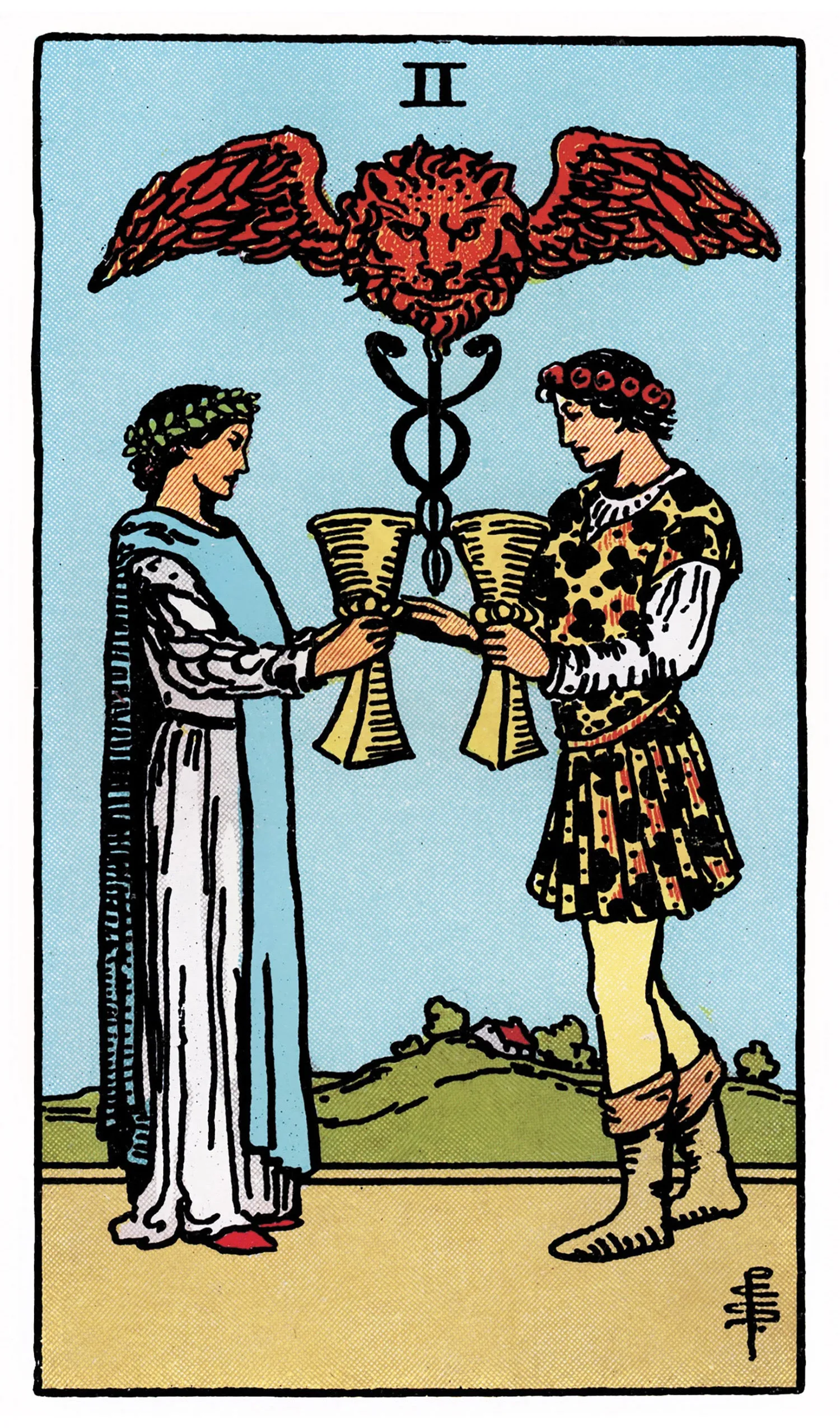
The Rider–Waite–Smith Two of Cups shows two figures facing one another and exchanging cups.
The image is unusually direct: the meaning does not exist inside one person alone.
It is created in the space between them.
The Two Figures Facing Each Other
Both figures are present and engaged.
Neither turns away.
This establishes the card's central theme of mutual recognition.
Each person sees the other and voluntarily participates in the exchange.
The image therefore emphasizes reciprocity rather than pursuit.
The Exchanged Cups
Each person holds a cup.
This is crucial.
One individual is not giving while the other remains empty-handed.
Both bring something emotional or relational into the interaction.
The cups symbolize exchange:
- affection;
- interest;
- trust;
- recognition;
- agreement;
- value.
They also symbolize the Two of Cups principle of give and take.
A healthy exchange allows both people to contribute and both people to receive.
The Caduceus
Between the figures appears a caduceus-like symbol associated with exchange, mediation, communication, and the interaction of complementary forces.
Within the card's visual language, it reinforces the idea that the connection is created through interaction rather than through isolated emotion.
Two different sides enter a shared space and attempt to create balance between them.
The Winged Lion
Above the caduceus appears a winged lion's head.
Its stronger, more instinctive quality adds passion and intensity to what might otherwise appear to be a purely gentle exchange.
This reminds us that the Two of Cups may involve not only emotional affection but also powerful attraction and chemistry.
Mutuality can be tender and intensely compelling at the same time.
The Distance Between the Figures
The two people are connected, but they remain separate individuals.
This is one of the most important details in the card.
Healthy partnership does not require two people to become identical.
They meet because each comes from their own position and chooses to participate in the exchange.
The space between them is where the relationship exists.
This also explains the shadow of the card:
if maintaining the bond requires one person to erase themselves, the exchange is no longer truly mutual.
The Core Symbolism of The Two of Cups
The Two of Cups is the image of reciprocity.
Two people face one another.
Both hold a cup.
Both participate.
The card's power therefore comes not simply from love, attraction, agreement, or partnership individually, but from the fact that the movement is returned.
Where the Ace says:
“Something is being felt or offered,”
the Two asks:
“Is there someone on the other side willing to meet you there?”
Upright, the answer is usually yes.
Reversed, the connection may still exist, but what separates the two sides becomes stronger than what connects them.
That is the essential mechanism of the Two of Cups.