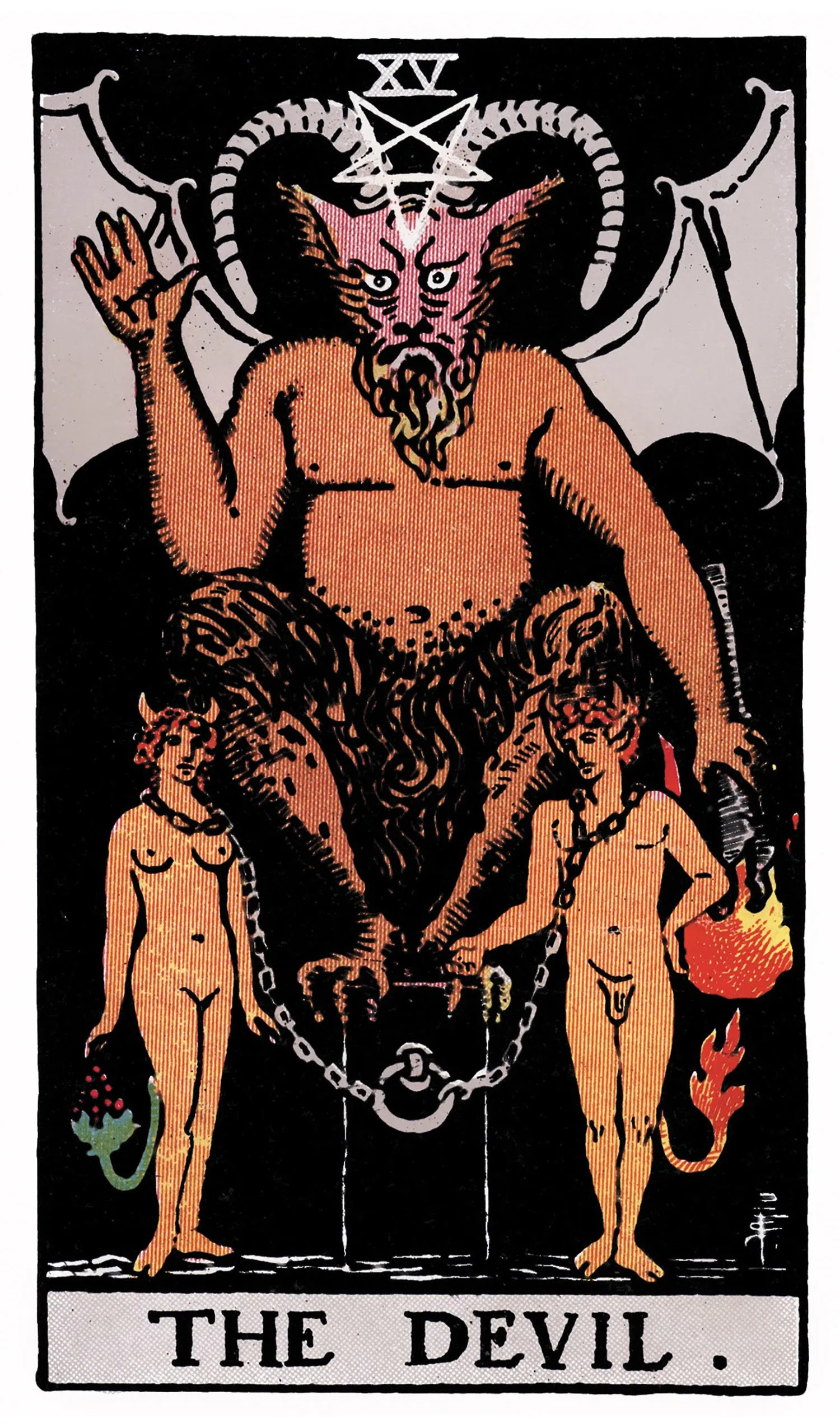
Major Arcana · Card XV
The Devil Tarot Card Meaning
The Devil represents attachment created through desire, benefit, pleasure, fear, power, or dependency. Its central mechanism is not simply that a person is trapped against their will: very often, they originally entered the situation voluntarily because it offered something they wanted. The difficulty begins later, when the reward, relationship, habit, agreement, or system becomes harder to leave than it was to enter.
The Devil can bring money, pleasure, influence, sexual attraction, status, or access to something highly desirable. It does not automatically mean failure. The problem is that the desired result may come with a price: reduced freedom, dependency, obligation, stagnation, or increasing influence from other people and circumstances.
Card Meanings
General Meaning
The Devil appears when something has become extremely attractive, rewarding, difficult to resist, or difficult to leave.
At the beginning, the person often has a choice. They may enter a relationship because of passion, accept a job because of money, take on an obligation because of an immediate advantage, tolerate an unhealthy situation because it provides security, or continue a habit because it offers pleasure or relief.
This is one of the most important mechanics of the card: the initial bond is often voluntary.
In the traditional image, the chains around the figures are not impossibly tight. In theory, they could leave. In practice, however, leaving becomes increasingly complicated because the Devil does not work through force alone. It works through desire, reward, fear of losing the reward, habit, dependency, and the consequences that accumulate around the original choice.
The Devil therefore frequently describes a situation in which personal choice is no longer the only force determining what happens. Other people, obligations, money, circumstances, systems, previous decisions, and external events may now be involved.
The person may still have agency, but agency alone may no longer be enough to produce an immediate change.
This makes the Devil a particularly sticky card. It can show a situation that continues without meaningful development because everyone involved remains caught inside the same mechanism.
At its strongest, the card can represent tremendous material motivation, magnetism, ambition, sexual energy, strategic awareness, and the ability to recognize what people truly want. It can help someone obtain a tangible advantage precisely because it is not idealistic.
But the Devil always raises an important question:
What is the real price of getting what you want?
The Shadow Side of The Devil
The Devil becomes destructive when desire begins to override judgment.
A person may know that a relationship, habit, deal, lifestyle, or ambition is damaging and continue anyway because the immediate reward still feels stronger than the long-term cost.
The card can therefore describe addiction, possessiveness, jealousy, greed, manipulation, exploitation, sexual obsession, financial dependency, compulsive behavior, or a willingness to tolerate unacceptable conditions in exchange for something desirable.
Its shadow can also be much quieter. A person may simply remain in a situation that stopped developing long ago because leaving would require giving up comfort, money, status, access, pleasure, security, or a familiar emotional pattern.
The Devil does not always lock the door.
Sometimes it makes staying attractive enough that the person stops trying to leave.
The Devil Reversed
The reversed Devil is not automatic liberation from the chains.
It shows the same mechanism in a more damaged, entrenched, excessive, or poorly controlled form.
Dependency may become stronger. Desire may become compulsive. Manipulation can become harsher. A person may lose more control over behavior they once believed they could manage.
What originally looked like a voluntary arrangement may now feel genuinely difficult to escape because too many additional factors have become involved.
The person can understand that the situation is unhealthy and still remain inside it.
In some cases, the reversed Devil shows the stage at which the benefit that originally justified the situation is becoming smaller while the cost becomes increasingly obvious.
The bond remains, but it is becoming harder to pretend that the exchange is worthwhile.
Core Message
The Devil asks you to look at what binds you without pretending that the bond appeared from nowhere.
Something was wanted.
Something was offered.
A choice was made.
The real question is whether the original reward is still worth everything that now comes with it.
The Devil as a Person
As a person, The Devil can describe someone powerful, magnetic, sensual, ambitious, pragmatic, and highly aware of what motivates other people.
This person often understands desire better than morality. They may know how to attract attention, negotiate through incentives, create dependency, use charm, or make themselves difficult to refuse.
They can be materially motivated and may place considerable importance on money, sex, status, pleasure, influence, or access.
At their best, they are realistic about human nature. They do not pretend that everyone acts from pure motives, and they may be unusually good at recognizing the real interests operating beneath polite explanations.
The difficult side is possessiveness, jealousy, greed, manipulative behavior, domination, obsessive tendencies, or using other people's vulnerabilities for personal advantage.
A Devil personality can also become dependent themselves. Someone who appears powerful externally may still be controlled by appetites, money, approval, sex, substances, status, or the need to possess something they fear losing.
The Devil as Actions
As actions, The Devil actively pursues what it wants.
The person may seduce, tempt, bargain, offer an attractive benefit, apply pressure, exploit an existing weakness, create dependency, maintain someone's interest, or deliberately make themselves difficult to leave.
The action may be direct, but it does not have to be. The Devil often works through incentives rather than commands.
Instead of saying, “You must stay,” it creates a situation in which staying feels more rewarding, easier, safer, or more pleasurable than leaving.
It can also show repeatedly returning to the same behavior despite knowing where it leads.
The Devil in Love and Relationships
In relationships, The Devil is one of the strongest cards of physical attraction, sexual chemistry, temptation, attachment, jealousy, possessiveness, and dependency.
Two people may find it extremely difficult to stay away from each other even when the relationship itself is unhealthy.
However, intense desire should not automatically be interpreted as love.
The Devil can show sexual attraction without emotional intimacy, obsession without genuine compatibility, and attachment without a healthy partnership.
People may remain together because of sex, money, lifestyle, shared obligations, fear, jealousy, convenience, status, emotional dependency, or simply because neither is ready to surrender what the relationship provides.
It can also represent affairs, forbidden attraction, complicated sexual dynamics, or relationships in which one person has discovered exactly what keeps the other person attached.
In an established relationship, The Devil may indicate a bond that is genuinely strong but has become difficult to change. The couple can repeatedly return to the same conflicts and behaviors without progressing beyond them.
The Devil as Thoughts
As thoughts, The Devil shows fixation.
The person thinks intensely about what they want, what they may lose, how they can obtain something, how they can keep it, or what they can use to maintain control over the situation.
In a romantic question, thoughts may be strongly sexual or possessive.
The person may repeatedly think about the querent, but frequency of thought should not automatically be mistaken for emotional depth. Someone can be mentally obsessed because they desire access, attention, sex, control, reassurance, or another benefit.
The Devil as Feelings
As feelings, The Devil primarily represents desire.
There can be powerful sexual attraction, hunger for the other person, jealousy, possessiveness, fascination, emotional dependency, or the feeling that someone has become difficult to resist.
It can feel intense precisely because the person experiences the connection as something they want very strongly.
The Devil is not naturally a card of gentle emotional openness, tenderness, or unconditional love. Those qualities require support from other cards.
Its emotional language is closer to:
I want you. I do not want to lose you. I cannot easily let this go.
The Devil as Intentions
As intentions, The Devil wants to obtain and retain access to what it desires.
A person may intend to continue a sexual relationship, maintain influence, keep someone emotionally attached, secure a material advantage, preserve a convenient arrangement, or ensure that the other person remains available.
This does not necessarily mean they intend to build a healthier or more developed relationship.
The Devil is often more interested in maintaining the existing bond than transforming it.
The Devil as an Outcome
As an outcome, The Devil does not automatically mean that the person fails to obtain what they want.
Quite the opposite: sometimes the desired result is achieved.
A relationship begins. Money is obtained. A deal is made. A position is secured. Pleasure is available. Someone gets access to the person or opportunity they wanted.
The problem is what the result becomes afterward.
The Devil can show a result that turns into an attachment, obligation, dependency, or trap. What looked like a reward becomes difficult to relinquish.
It can also indicate that the situation becomes firmly established without developing further. People remain connected, but the relationship does not grow. The job continues, but the person cannot move forward. The same behavior repeats without producing a new stage.
In this sense, The Devil is often a card of being stuck inside an existing mechanism.
The result may therefore be tangible but not liberating.
The Devil in Career and Work
In career, The Devil can be extremely ambitious and materially motivated.
It may describe competitive environments, corporate power, strong financial incentives, business built around desire or consumption, aggressive negotiation, office politics, influence, status, or work where people understand exactly what motivates others.
It can indicate a lucrative position.
However, high reward may come with restrictive conditions.
The classic expression is a form of “golden handcuffs”: the salary, lifestyle, title, connections, or benefits are attractive enough that the person stays even when the work itself has become unhealthy.
The card may also indicate unethical pressure, exploitation, manipulation, dependency on a particular employer or client, or a professional environment in which everyone has something to gain and therefore tolerates behavior they would otherwise reject.
For business, The Devil can be commercially powerful because it understands demand. It is particularly good at identifying what people want and turning desire into money.
But it can also encourage short-term profit at the expense of independence or integrity.
The Devil in Money and Finances
The Devil is strongly connected with the material sphere and can indicate substantial financial motivation, profit, business opportunity, access to resources, or a powerful desire to earn more.
Unlike many cards whose strength lies outside the material sphere, The Devil understands money very well.
But it rarely represents money without attachment.
This can mean debt, credit, loans, financial obligations, dependence on another person's money, dependence on a particular income source, expensive habits, compulsive spending, or remaining in an unwanted arrangement because it is financially advantageous.
The Devil can therefore show both having money and being controlled by money.
In financial decisions, attractive terms should be examined carefully. Immediate gain can conceal long-term obligations.
The Devil in Health
Within the Tarovera Tarot health system, the upright Devil is generally associated with good health.
A specific combination rule is important: The Devil together with the Ten of Swords may be read within this Tarot system as an indication of appendicitis or another sudden situation requiring urgent medical attention. This is a combination meaning and should not be assigned to The Devil alone.
These are Tarot associations rather than medical diagnoses.
Tarot should not be used as a substitute for medical diagnosis or treatment.
The Devil Timing — When Will It Happen?
The Devil corresponds to late December or early January.
When the question is not “when?” but “how long will it take?”, The Devil usually indicates a long period.
This is a sticky, viscous card. Rather than showing active progress through time, it can describe a situation that remains caught in essentially the same state for a long period, like being stuck in a bog.
Development may be minimal even though the situation itself continues.
Sometimes the true turning point comes only when the person becomes sufficiently tired of remaining in the same condition and finally begins trying to leave it.
Even then, departure may not be immediate.
The chains of The Devil are not impossibly tight, but the person originally entered the situation voluntarily for some reward, advantage, pleasure, promise, or temptation. By the time they want to leave, other people, obligations, circumstances, and consequences may also be involved.
Key Timing Correspondence
When? Late December / early January.
How long? Usually a long time. The situation may remain stagnant until the person becomes unwilling to tolerate it any longer, and even then external factors can delay change.
The Devil as an Event
As an event, The Devil can indicate an encounter with something extremely tempting.
This may be a profitable offer, powerful sexual attraction, an affair, a financial arrangement, a loan, a binding agreement, an encounter with a magnetic but controlling person, or an opportunity whose benefits make its disadvantages easier to ignore.
The event itself may initially feel positive because the reward is real.
The significance becomes clearer later, when the person discovers what maintaining that reward requires.
The Devil can also manifest as becoming caught in a repeating situation: returning to someone, resuming a habit, taking on another obligation, or remaining inside circumstances that no longer develop.
The Devil as Card of the Day
As Card of the Day, The Devil suggests that desire, money, attraction, ambition, temptation, or power dynamics may become unusually noticeable.
Something may look difficult to refuse.
You may strongly want a purchase, a person, an opportunity, a particular result, or the satisfaction of an immediate urge.
The day is useful for noticing what actually motivates you rather than pretending your motives are more idealistic than they are.
Enjoyment itself is not the problem.
The important question is what agreement you are making in exchange for it.
The Devil as Advice
As advice, The Devil asks you to become brutally realistic about motivation.
Identify what you actually want.
Do not pretend that money, attraction, sex, status, power, pleasure, convenience, or personal benefit are irrelevant if they are in fact driving the situation.
Understand what the other person wants as well.
The Devil can advise using incentives, attraction, negotiation, material leverage, or strategic understanding rather than relying on idealistic expectations.
At the same time, know the price before accepting the benefit.
If you deliberately enter an arrangement because it gives you something valuable, establish where your limits are and what would make you leave before the situation becomes harder to control.
The Devil Reversed as Advice
Recognize that the attachment may already be stronger than you expected.
Do not assume that simply deciding to stop will automatically remove the practical forces maintaining the situation.
Look at the entire mechanism: the reward, the habit, the people involved, financial interests, obligations, fear, convenience, and the external circumstances that keep the pattern functioning.
A deeply established Devil situation usually has to be dismantled at more than one level.
The Devil as a Warning
The Devil warns against confusing having a choice at the beginning with having the same degree of freedom later.
A tempting situation can become structurally difficult to leave.
Be careful with offers whose immediate benefit is obvious while the long-term cost remains vague.
The danger may be hidden in dependency: financial dependency, sexual dependency, emotional dependency, status, habit, addiction, power, or simply the fear of losing something pleasurable.
The card also warns against believing that you remain fully in control merely because you entered the situation voluntarily.
At some point, other people and circumstances may begin influencing what happens next.
The Devil — Yes or No
Upright: No
The Devil gives a No.
Even when the card promises something desirable, it carries too much attachment, distortion, dependency, stagnation, or hidden cost to function as a clean affirmative answer.
Reversed: No
The reversed Devil also gives a No.
The underlying mechanism is not improved in the reversed position; it is more impaired, excessive, destructive, or difficult to control.
The Devil Symbolism
The Rider–Waite–Smith Devil presents a scene of bondage in which the figures appear trapped, yet the image deliberately shows that their chains are not impossibly tight.
This is central to the card.
The symbolism is not simply about imprisonment.
It is about participation in the mechanism of one's own attachment.
The Chains
The man and woman are chained to the pedestal, but the chains hang loosely around their necks.
This reflects one of the Devil's most important principles: the bond is powerful without necessarily being physically absolute.
The people could theoretically leave.
The real difficulty lies in desire, habit, fear, reward, dependency, and everything that has developed around the original choice.
The Man and Woman
The figures echo the couple from The Lovers, but the quality of connection has changed.
Instead of free choice opening toward relationship and possibility, desire has become attachment.
The image therefore suggests that choice has consequences.
A decision freely made at one stage can later create conditions that restrict future choices.
The Horns and Animal Features
The increasingly animal features of the figures represent the dominance of instinct, appetite, desire, and immediate gratification.
The symbolism does not suggest that instinct itself is evil.
Rather, it shows what happens when appetite becomes powerful enough to organize the person's behavior.
The Tails
The tails reinforce the connection with instinctive desire.
Their imagery is associated with appetite, pleasure, sexuality, and material attraction.
They visually suggest that the people have gradually adapted themselves to the environment in which they remain.
The Devil's Position
The Devil dominates the scene from above.
This reflects the way a system, desire, dependency, person, or external force can begin to acquire power once the participants have invested themselves in it.
What began as a personal choice can eventually become something larger than the individual.
The Inverted Pentagram
The inverted pentagram emphasizes material and instinctive forces dominating higher judgment.
In practical interpretation, this supports themes of appetite, material motivation, fixation, and the tendency to organize one's choices around what is immediately desirable.
The Torch
The downward torch emphasizes desire directed into the material and instinctive level.
It adds intensity, heat, sexuality, temptation, and destructive potential to the card.
Fire here does not necessarily create progress.
It can keep the existing appetite alive.
The Dark Background
The black background removes perspective.
There is little sense of distance, horizon, or future direction.
This strongly supports the Devil's relationship with stagnation.
When a person is deeply inside the mechanism of the card, the immediate attachment can become so dominant that alternative possibilities are difficult to see.
The Core Symbolism of The Devil
The Devil's image is ultimately about a bond that is both voluntary and difficult to escape.
The figures are not shown behind locked doors. Their chains are loose enough to suggest that personal choice still matters.
Yet they remain.
That contradiction is the heart of the card.
The Devil shows how desire can create its own form of captivity: a person accepts something because it offers a reward, adapts to the situation, becomes increasingly connected to it, and eventually discovers that leaving requires far more than simply changing their mind.
The card therefore does not say that human beings have no freedom.
It shows how freedom can gradually become limited by the consequences of what we repeatedly choose.