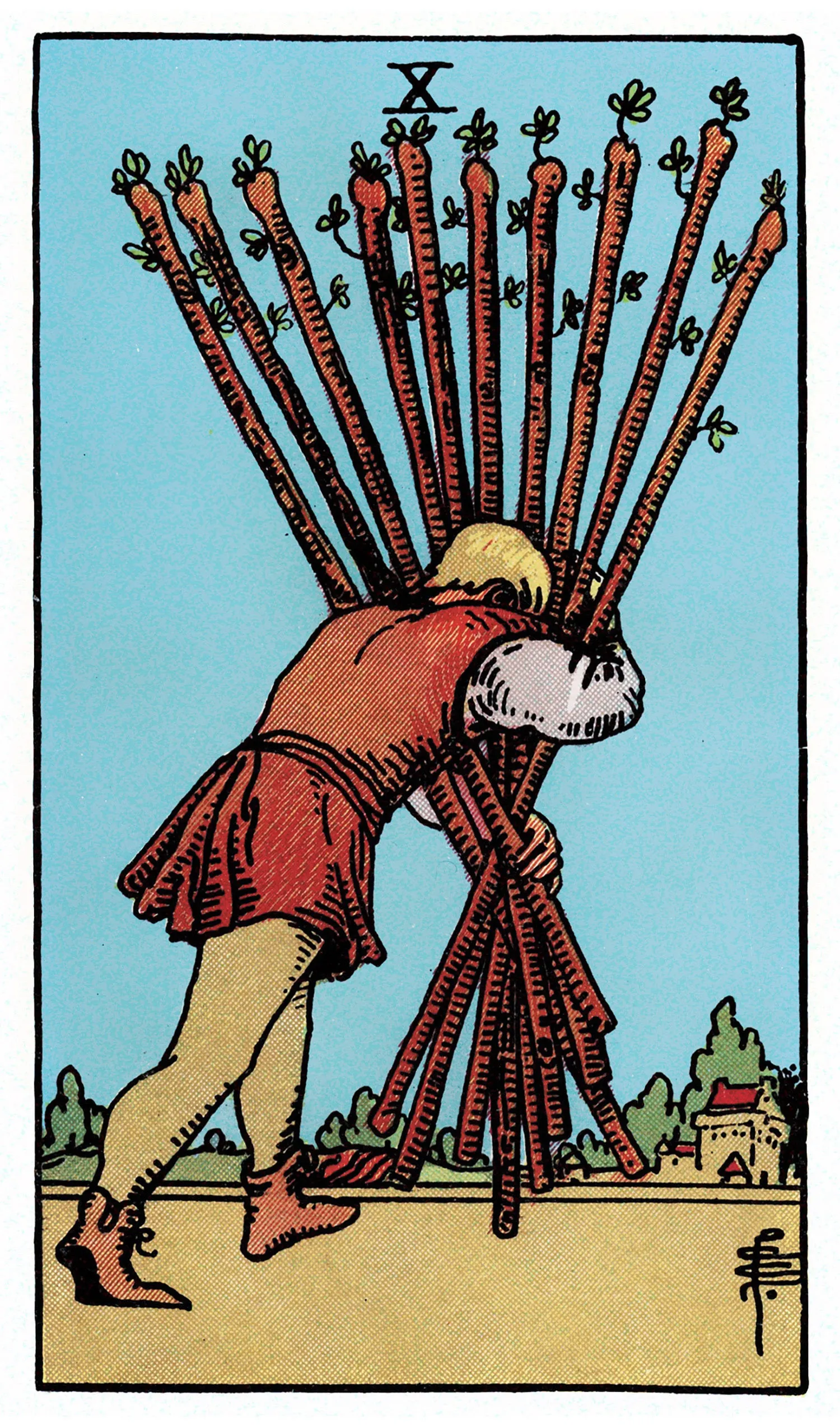
Minor Arcana · Wands · Ten
The Ten of Wands Tarot Card Meaning
The Ten of Wands represents reaching the limit of what one person can reasonably carry. The goal may already be close, and the person may still be capable of finishing what they started, but the burden has become excessive. This is the card of responsibility, pressure, overwork, and reaching the final stretch with almost no strength left.
Card Meanings
General Meaning
The Ten of Wands appears when a person has taken on more than is comfortable, sustainable, or even reasonable and is now carrying the full weight of those obligations.
This is not primarily a card of weakness or failure. In fact, it often appears because the person has already proven that they are capable, dependable, and willing to work harder than others. The problem is that their strength has gradually become a reason to place even more responsibility on them.
The card often describes the feeling that everything depends on you. There may be work to finish, people to support, deadlines to meet, promises to keep, bills to pay, or several problems demanding attention at the same time.
The destination is often close. The Ten is the end of the suit, so much of the journey has already been completed. However, the final stage is not easy. The person may reach the result, but the cost can be extreme fatigue, stress, physical depletion, or the realization that the entire process was made unnecessarily difficult.
Sometimes the burden was not present from the beginning. A promising idea, opportunity, relationship, position, or project may gradually have accumulated so many responsibilities that the person can barely see the original goal anymore.
The Ten of Wands therefore asks an important question: are all of these responsibilities genuinely yours?
Sometimes the card represents unavoidable duty. At other times, the person has simply become accustomed to taking everything on themselves, refusing help, trying to meet everyone's expectations, or believing that no one else can do the job properly.
The card can produce a result, but it does not describe a healthy or sustainable way of achieving it.
The Shadow Side of The Ten of Wands
The difficult side of the Ten of Wands appears when responsibility becomes self-destructive.
A person may take pride in being the one who can handle everything and gradually lose the ability to recognize their own limits.
Perfectionism can be an important part of this pattern. The person may believe they must do everything correctly, fulfil every promise, satisfy everyone involved, and never allow other people to see them struggling.
There may also be a fear of disappointing people or being seen as selfish, weak, unreliable, or inadequate if they refuse another responsibility.
In some cases, the hidden motive is pride:
“I can handle it.”
“No one else will do it properly.”
“I do not need help.”
This can gradually create the very situation the person later resents.
There can also be a martyr-like quality: “Everything is on me. No one helps me.” Sometimes this is objectively true. In other cases, the person has unintentionally created this situation by taking control of everything and not allowing others to participate.
The Ten of Wands can narrow a person's perception. When all attention is focused on surviving the workload, there is little energy left for relationships, creativity, pleasure, strategy, or even noticing whether the original goal is still worth pursuing.
The Ten of Wands Reversed
Reversed, the Ten of Wands shows that the burden has exceeded the person's actual capacity.
They may still be trying to carry everything, but they are no longer doing it effectively. Exhaustion begins to affect concentration, judgment, reliability, emotional stability, and the ability to complete what was promised.
Responsibilities may begin falling out of their hands. Deadlines can be missed. Tasks are abandoned. The person may become irritable, scattered, emotionally depleted, or physically unable to maintain the same pace.
The reversed card can involve releasing responsibilities, but this should not automatically be interpreted as healthy liberation.
Often the release happens because the person has reached a point where continuing is simply impossible.
Something may have to be dropped, postponed, delegated, or abandoned because the previous level of pressure can no longer be sustained.
Core Message
You may be capable of carrying the load, but capability does not mean that you should carry everything alone.
The Ten of Wands marks the point where persistence must be balanced with limits. Finish what genuinely matters, but recognize which burdens are unnecessary before exhaustion makes the decision for you.
The Ten of Wands as a Person
The Ten of Wands person is responsible, hardworking, dependable, and capable of enduring considerable pressure.
This is often someone who is accustomed to solving problems rather than waiting for other people to solve them. They may be the person others rely on in a family, workplace, business, or difficult situation.
They usually have a strong sense of duty. If they have promised something, they feel responsible for seeing it through even when circumstances become uncomfortable.
However, this person often has difficulty recognizing where responsibility should end.
They may be highly demanding of themselves and feel that they constantly need to prove that they can manage more.
Sometimes they have moved quickly into a level of responsibility that is difficult to sustain — for example, a demanding position, business, family role, or lifestyle that requires considerably more effort than expected.
They may also fear disappointing other people and therefore agree to obligations they do not genuinely want.
Because they repeatedly prove that they can cope, people around them may gradually become accustomed to giving them even more to carry.
They can be extremely productive, but their lifestyle may become dominated by obligations.
The Ten of Wands as Actions
As actions, the Ten of Wands shows someone continuing despite exhaustion.
They work, carry responsibilities, solve problems, meet obligations, complete tasks, and keep moving toward the finish even when the process has become extremely demanding.
This person may:
- take responsibility for several things at once;
- work overtime;
- cover for other people;
- carry a project almost single-handedly;
- refuse to abandon an obligation;
- keep pushing because the end is already close;
- take on work that should realistically be shared;
- continue fulfilling expectations even when they no longer have the energy.
Their actions are determined more by duty than by enjoyment.
The Ten of Wands in Love and Relationships
In relationships, the Ten of Wands usually describes pressure rather than ease.
The relationship may still exist, and feelings may still be present, but the connection has become surrounded by responsibilities, practical problems, emotional weight, or obligations.
One partner may feel that they are carrying the relationship alone.
This can include handling the household, children, finances, emotional support, planning, practical responsibilities, or continually solving the other person's problems.
The card can also appear when the relationship itself is not necessarily bad, but external circumstances make being together exhausting.
There may be work stress, financial difficulties, family responsibilities, relocation, caregiving, or several practical problems at once.
Another important manifestation is staying in the role of the “good partner” because the person feels they must.
They may continue giving, helping, solving, forgiving, organizing, or sacrificing because they are afraid that refusing will disappoint the partner or threaten the relationship.
Love can gradually become mixed with guilt and duty:
“If I stop carrying this, I am letting them down.”
“If I stop doing everything, maybe they will stop loving me.”
The relationship can therefore continue not only because of affection, but because the person feels responsible for keeping it alive.
The central feeling is often:
“I am still doing this, but it is becoming too much.”
The Ten of Wands does not automatically mean that love has disappeared. It means that whatever feelings exist are being forced to operate under heavy pressure.
The Ten of Wands as Thoughts
As thoughts, the Ten of Wands shows a mind occupied with responsibility.
The person may think:
“I have too much to deal with.”
“I need to finish this.”
“I have to handle it.”
“No one else is going to do it.”
“I cannot let them down.”
They may think about the relationship or situation primarily in practical terms: obligations, consequences, problems, what needs to be done, and how much effort will be required.
The person may still want the connection, but their mental space is heavily occupied by pressure.
The Ten of Wands as Feelings
The Ten of Wands is not a particularly strong card of romantic emotion.
It does not necessarily indicate lack of feeling, but whatever emotions exist are overshadowed by tiredness, pressure, obligation, guilt, or emotional responsibility.
A person may care deeply and still feel exhausted by the relationship.
They may feel responsible for the other person, attached to them, unwilling to abandon them, or determined to continue — but this is very different from light, spontaneous romantic joy.
There may also be guilt about disappointing the partner or fear that love depends on continuing to carry the relationship.
The emotional experience is heavy.
The Ten of Wands as Intentions
As intentions, the Ten of Wands usually means that the person intends to keep going.
They want to finish what they started, fulfil their obligations, keep their promises, or carry the situation through to the end.
Even if the relationship has become difficult, they may not intend to walk away immediately. Duty and responsibility can be stronger than comfort.
The card often says:
“I will carry this as far as I can.”
Sometimes this intention comes partly from love and partly from guilt, fear of disappointing the other person, or the belief that abandoning the responsibility would make them a bad partner.
The Ten of Wands as an Outcome
As an outcome, the Ten of Wands can show that the situation reaches its final stage, but only through considerable effort.
The result may be achieved, especially if the person is already close to completion, but it comes with pressure, fatigue, and the feeling that far too much was required to get there.
This is not an easy victory.
The person may finish the project, resolve the problem, complete the journey, or fulfil the obligation and then realize how depleted they have become.
The card can therefore represent success at a very high personal cost.
The Ten of Wands in Career and Work
The Ten of Wands is one of the clearest cards of professional overload.
It can describe:
- excessive workload;
- overtime;
- several projects running simultaneously;
- unrealistic deadlines;
- responsibility for other employees;
- doing the work of several people;
- running a business almost alone;
- being the person everything depends on;
- carrying a demanding project through its final stage.
The card often appears around highly capable people precisely because other people know they can be relied upon.
Professional competence is therefore not the problem. The problem is that the entire working structure may have become dependent on one person's willingness to keep absorbing additional responsibilities.
The Ten of Wands can also describe the price of success that has already been achieved.
A person may already have the promotion, senior position, business, reputation, client base, high income, or professional status they wanted — and now discover that maintaining it requires enormous ongoing effort.
The opportunity itself may have been successful.
The burden comes afterward.
More money can mean more responsibility. A higher position can mean constant decisions, employees, deadlines, and pressure. A successful business can become something the owner cannot leave unattended even for a day.
In this form, the Ten of Wands is not saying:
“You failed to succeed.”
It says:
“You succeeded, and now you have to carry everything that success created.”
Sometimes a person earns well but has little time, energy, or freedom left to enjoy what they have earned.
The Ten of Wands can therefore show both a final push toward professional completion and the heavy cost of maintaining a level already reached.
It may produce results, but the current working model is not sustainable indefinitely.
The Ten of Wands in Money and Finances
Financially, the Ten of Wands is more closely connected with financial burden than with wealth itself.
There may be money coming in, but much of it is already committed.
The card can indicate:
- loans;
- regular payments;
- high household costs;
- business expenses;
- supporting other people;
- several financial obligations at once;
- working extremely hard to maintain the current standard of living.
A person may technically be managing their finances while still feeling that the entire structure rests on constant effort.
Property can also become part of this burden.
A house purchase, renovation, construction project, mortgage, maintenance costs, or other major material commitment may require far more money, time, and energy than originally expected.
The asset itself may be valuable or desirable while the process of maintaining, repairing, completing, or paying for it becomes exhausting.
The card can also describe earning money through difficult, exhausting, or highly demanding work.
It does not promise easy profit.
The Ten of Wands in Health
In the Tarovera Tarot health system, the upright Ten of Wands is associated with conditions connected with heavy physical or psychological strain, overwork, and excessive load.
Traditional associations within this system include the spine, bones and limbs, as well as elevated blood pressure and health problems aggravated by sustained overload or exhaustion.
The central Tarot theme is a body carrying more pressure than is comfortable or sustainable.
These are Tarot-system associations, not medical diagnoses.
Tarot should not be used as a substitute for medical diagnosis or treatment.
The Ten of Wands Timing — When Will It Happen?
The Ten of Wands often does not describe an event that is still waiting somewhere in the future.
Its timing is very similar to the Nine of Wands: the relevant event may already have happened, the situation may already have reached its conclusion, or the opportunity connected with the question may effectively be closed.
In timing questions, this can be a “the door is already closed” card.
Rather than giving a future waiting period, the Ten of Wands may show that the important moment has already passed.
Key Timing Correspondence
Already happened / already completed / the opportunity window has closed.
The Ten of Wands as an Event
As an event, the Ten of Wands often brings a period of intense responsibility.
A person may suddenly find themselves responsible for several problems at once, be given a major workload, have to finish a demanding project, take over someone else's duties, or deal with a situation where too much depends on them personally.
The event itself may not be dramatic. What makes it significant is the amount of effort required.
It can also describe the final push before something is completed.
Another possible manifestation is discovering the hidden cost of something already achieved: a promotion brings overwhelming responsibility, a successful business creates constant work, or a desired purchase creates major obligations.
The Ten of Wands as Card of the Day
Today may bring more responsibility than expected.
Several tasks may demand attention at once, or you may find yourself doing something that would ideally be shared between several people.
The day can still be productive, especially if something important is close to completion, but energy needs to be managed carefully.
Pay attention to the tendency to say yes merely because you do not want to disappoint someone.
Do not automatically accept every additional request simply because you are capable of handling it.
The Ten of Wands as Advice
Finish what genuinely needs to be finished, but stop treating every responsibility as equally important.
Prioritize.
Delegate where possible.
Do not take on new obligations simply because you are accustomed to being the person who can cope.
Do not confuse responsibility with the need to please everyone.
If the goal is already close, one final effort may be justified — but only if you understand what that effort will cost.
Strength is not proven by carrying everything alone.
The Ten of Wands Reversed as Advice
Do not wait until exhaustion makes the decision for you.
Reduce the load before your ability to function begins to collapse.
If something cannot realistically be completed with the time, energy, or resources available, acknowledge that now rather than continuing to promise what you can no longer deliver.
The Ten of Wands as a Warning
The Ten of Wands warns that you may reach your goal and still damage yourself in the process.
The problem is not necessarily the goal itself.
The danger lies in excessive responsibility, perfectionism, refusing help, trying to meet everyone's expectations, overestimating how long you can maintain the current pace, and allowing other people's problems to become your permanent burden.
Be especially careful when pride says:
“I can do everything myself.”
Being capable of carrying something does not automatically make it your responsibility.
The Ten of Wands — Yes or No
Upright: Yes, but at the cost of enormous effort and exhaustion
The answer can be yes, but nothing about this path is easy.
Getting what you want may require carrying an extreme workload, accepting significant responsibility, and spending far more energy than initially expected.
The result may be possible.
The real question is whether the price is worth paying.
Reversed: Not worth it — you will burn out
The reversed Ten of Wands does not simply say that something is impossible.
It warns that pushing for this result is likely to demand more than you can sustainably give.
Even if you manage to force the situation forward for a while, the cost can be exhaustion, loss of control, or burnout.
A Yes/No card should never be read in isolation from the actual question, spread position, and surrounding cards.
The Ten of Wands Symbolism
The Rider–Waite–Smith Ten of Wands shows a figure carrying ten heavy wands toward a settlement in the distance.
The image captures the card's central contradiction: the destination is close, but the person is so consumed by the burden that almost everything else disappears from view.
The Ten Wands
All ten wands are carried at once.
The number itself reinforces completion, but the way the wands are being carried shows that completion has accumulated weight.
Each individual responsibility may once have been manageable. Together they have become difficult to sustain.
The Bent Posture
The figure bends forward beneath the load.
This suggests pressure, fatigue, and the physical reality of carrying too much.
The card does not show someone casually holding responsibility. It shows responsibility becoming something the entire body must compensate for.
The Obstructed View
The bundle of wands blocks much of the person's view.
This reflects one of the psychological dangers of the card: excessive responsibility can narrow perception.
A person can become so focused on obligations that they stop seeing alternatives, help, pleasure, relationships, or a more efficient way of reaching the same goal.
It can also symbolize losing sight of why the burden was taken on in the first place.
The Nearby Destination
The town in the distance is important because the journey is almost complete.
The card therefore differs from endless struggle.
There is a destination.
The person has already travelled most of the way.
The difficulty lies in surviving the final stage without being crushed by what they are carrying.
Carrying Everything Alone
No one else appears to be helping.
This reflects one of the strongest themes of the Ten of Wands: self-imposed or externally imposed responsibility concentrated on one person.
The image raises the question of whether the load truly needs to be carried this way — and whether refusing help has become part of the problem.
The Core Symbolism of The Ten of Wands
The Ten of Wands symbolizes the final stage of a process in which effort has accumulated into burden.
The person is strong enough to continue, the goal is close enough to see, and completion remains possible — but the method has become costly.
What may once have represented ambition, opportunity, or success can now require constant effort simply to maintain.
Its central visual message is not:
“You cannot do this.”
It is:
“You may be able to carry it, but you are carrying too much.”