Minor Arcana · Cups · Knight
The Knight of Cups Tarot Card Meaning
The Knight of Cups represents active movement driven by emotion, attraction, imagination, and the desire to pursue something that feels beautiful or meaningful. Unlike the Page, who primarily brings a message or signal, the Knight acts: he approaches, invites, proposes, reconciles, courts, negotiates, or carries a pleasant offer into the situation.
His initiative is real, but his judgment is not always completely sober. Even upright, the Knight of Cups can wear rose-colored glasses, idealize people and opportunities, and sincerely believe in a beautiful scenario before checking whether reality can support it.
Card Meanings
General Meaning
The Knight of Cups brings movement into the emotional world.
He is not merely a messenger. Pages tend to announce, inform, or introduce something; Knights actively move the situation forward. The Knight of Cups approaches what attracts him and often arrives carrying something pleasant with him: an invitation, proposal, apology, romantic gesture, interesting information, encouraging news, or an emotionally appealing opportunity.
This card frequently shows that someone or something pleasant is approaching. A person comes closer. Communication begins. An offer arrives. A meeting is arranged. Someone decides to make the first move.
The Knight acts according to the nature of Cups. His motivation comes from feelings, imagination, sympathy, beauty, emotional attraction, and the desire to create a pleasant response.
Because of this, his style is very different from the fiery Knight of Wands. The Knight of Wands moves with fire in his hands and excitement in his eyes. The Knight of Cups moves because something has emotionally captured him.
His strength is his ability to turn feelings into movement.
His weakness is that the movement may begin before sober judgment has caught up.
Even upright, the Knight of Cups can show naivety, idealization, and rose-colored glasses. He may genuinely believe that a person is wonderful, that an opportunity is perfect, or that a romantic story will develop exactly as imagined.
This does not automatically mean deception.
Very often, the Knight sincerely believes what he is saying at the moment. The problem is that emotional truth and objective reality are not always the same thing.
The card can therefore show a genuine proposal without guaranteeing that the proposal will become a stable, practical, long-term result.
The Shadow Side of The Knight of Cups
The shadow of the Knight of Cups appears when imagination begins to replace observation.
He may fall in love with an image of a person rather than the complete person. He may become enthusiastic about an opportunity because it sounds beautiful while overlooking its practical limitations.
He can also become attached to the experience of romance itself.
Sometimes the Knight is not only in love with someone — he is in love with being in love. Courtship, meaningful gestures, emotional intensity, special dates, beautiful words, symbolic gifts, music, places, and shared memories may become extraordinarily important to him.
Another important shadow mechanism is projection.
The Knight of Cups can idealize other people, but other people can also idealize him. Because he appears charming, sensitive, romantic, emotionally expressive, or attentive, someone may project their own dream partner onto him and attribute feelings, intentions, maturity, or commitment that he has never actually demonstrated.
The illusion therefore does not always originate with the Knight.
Sometimes another person finishes the story for him.
The Knight of Cups Reversed
Reversed, the Knight's emotional nature becomes more distorted, unrealistic, inconsistent, or poorly directed.
The rose-colored glasses become stronger.
A person may ignore inconvenient facts because they interfere with what they desperately want to believe. Fantasy, emotional expectation, romantic projection, and wishful thinking begin to replace sober perception.
This can manifest as:
- self-deception;
- unrealistic expectations;
- emotional inconsistency;
- escapism;
- promises made under the influence of the moment;
- excessive romanticization;
- seduction without sufficient substance;
- inability to follow through;
- emotional manipulation.
The reversed Knight does not necessarily lack feelings.
Often he feels intensely.
The problem is that emotion is no longer sufficiently connected to reality, responsibility, or consistency.
He may sincerely say, “I want this,” and truly believe it today, yet be unable to sustain the same intention tomorrow.
The reversed card can also show blocked movement: an invitation is withdrawn, a meeting is cancelled, a pleasant message is delayed, a trip does not happen, or someone wants to approach but hesitates, retreats, or fails to act.
Core Message
The Knight of Cups turns emotion into movement.
Follow what attracts and inspires you, but remember that a beautiful feeling, sincere intention, or attractive offer still needs reality and consistent action behind it.
The Knight of Cups as a Person
The Knight of Cups is usually charming, emotionally expressive, imaginative, diplomatic, and sensitive to atmosphere.
This person knows how to approach others without excessive pressure.
They may be skilled at:
- compliments;
- flirting;
- pleasant conversation;
- romantic gestures;
- reconciliation;
- persuasion;
- creating emotional connection;
- making an idea attractive.
They often appreciate beauty, music, art, storytelling, atmosphere, aesthetics, romance, and emotionally meaningful experiences.
The Knight prefers attraction to force.
Rather than pushing someone, he tries to create a situation that makes the other person want to move toward him.
He can also be genuinely kind and peace-loving. When other people are arguing, this Knight often tries to soften the atmosphere, find words everyone can accept, restore contact, or create compromise.
At the same time, he may be naive.
He can believe people because he wants to believe the beautiful version of the story.
And because he himself can appear unusually attractive, romantic, or emotionally available, other people may idealize him as well.
The Knight of Cups as Actions
The Knight of Cups acts.
He may:
- contact someone;
- come to see them;
- invite them somewhere;
- arrange a date;
- make a romantic gesture;
- apologize;
- suggest reconciliation;
- confess feelings;
- make an attractive proposal;
- bring pleasant information;
- deliver encouraging news;
- offer cooperation;
- negotiate;
- try to resolve a disagreement peacefully;
- pursue something that emotionally inspires him.
The key distinction is movement.
He does not simply inform the situation that something exists. He enters the situation and attempts to develop it.
His action is usually attractive rather than aggressive.
He wants agreement, response, emotional participation, or voluntary movement from the other side.
The Knight of Cups in Love and Relationships
Love is one of the Knight of Cups' strongest natural spheres.
The card can indicate:
- romantic pursuit;
- courtship;
- flirting;
- a date;
- an invitation;
- confession of feelings;
- affectionate communication;
- reconciliation;
- an apology;
- someone actively moving toward another person.
For a new connection, the Knight often shows that attraction begins to turn into real interaction.
Someone does not merely think or feel — they start doing something about it.
In an existing relationship, the card can bring renewed romance, affectionate gestures, dates, emotional conversations, gifts, reconciliation, or an attempt to restore warmth.
The Knight of Cups can also describe the honeymoon stage of a relationship.
The emotions may be genuine and the connection may be very enjoyable, while both people still see primarily the beautiful parts of each other.
Being sincerely in love does not necessarily mean seeing someone clearly.
This distinction is central to the card.
The Knight can genuinely love while simultaneously idealizing.
He may also become attached to the romantic experience itself: the messages, dates, symbols, gifts, songs, anniversaries, promises, and feeling that the connection is special.
This is why the card should not automatically be translated into marriage or permanent commitment.
It is extremely strong for romance, attraction, pursuit, emotional offers, and beautiful moments.
Long-term stability must still be demonstrated elsewhere.
The Knight of Cups as Thoughts
In Thoughts, the Knight of Cups thinks about approaching.
The person may be considering:
- contacting someone;
- arranging a meeting;
- making an invitation;
- expressing affection;
- apologizing;
- reconciling;
- making a proposal;
- creating a pleasant emotional interaction.
Their mental focus tends to be optimistic and romantic.
They often think first about what could be beautiful about the situation and only later about what could make it difficult.
This can therefore be hopeful thinking without being completely objective thinking.
The Knight of Cups as Feelings
As Feelings, the Knight of Cups is strong.
There is emotional attraction, romantic interest, tenderness, fascination, affection, emotional excitement, and the desire to become closer.
The person may feel inspired by someone.
They may experience the connection as beautiful, special, or emotionally significant.
These feelings can be completely sincere.
But sincerity does not eliminate idealization.
The person may genuinely be in love while still seeing the partner through rose-colored glasses.
The Knight of Cups as Intentions
The Knight of Cups intends to move toward the situation.
He wants to:
- contact;
- invite;
- approach;
- express feelings;
- make peace;
- create closeness;
- present an offer;
- improve the atmosphere;
- pursue what attracts him.
His intention is generally genuine at the emotional level.
However, the card does not automatically show that he has calculated the long-term consequences of what he wants.
The Knight may sincerely intend to create something beautiful without yet understanding what maintaining it will require.
The Knight of Cups as an Outcome
As an Outcome, the Knight of Cups usually shows movement toward a pleasant emotional development.
Someone may approach.
An invitation may arrive.
Communication may become warmer.
A romantic or professional proposal may appear.
A reconciliation may begin.
A pleasant meeting may take place.
The outcome therefore often brings something encouraging toward the querent.
The card is especially strong for the arrival of pleasant information, an attractive offer, or a person who actively brings movement into the situation.
However, the Knight represents movement and proposal more strongly than final completion.
If the question concerns a concrete result such as permanent commitment, signed agreements, major profit, or completion of a difficult project, other cards should show whether the offer actually becomes material reality.
The Knight of Cups in Career and Work
In Career, the Knight of Cups is strong wherever creativity, emotional intelligence, communication, diplomacy, presentation, aesthetics, or interpersonal connection matter.
It can indicate:
- an attractive job offer;
- a pleasant business proposal;
- negotiations;
- pitching an idea;
- meeting a useful person;
- client communication;
- creative projects;
- PR and marketing;
- hospitality;
- beauty and design;
- artistic work;
- counseling;
- mediation;
- relationship-based professions.
The Knight can sell an idea because he knows how to make people feel something about it.
He can also be productive when inspired.
However, his creative independence is often stronger than his administrative independence.
The Knight may have vision, taste, talent, enthusiasm, and the ability to connect with people while struggling more with:
- routine;
- accounting;
- structure;
- strict schedules;
- long-term administration;
- repetitive execution.
For some Knight of Cups personalities, working with a strong manager, organizer, producer, or operational partner can be extremely useful.
The Knight of Cups in Money and Finances
In finances, the Knight of Cups can indicate pleasant financial information, an attractive offer, a payment, advance, expected money, or a proposal connected with money.
Unlike a Page, however, the Knight often shows not simply hearing about the possibility but movement already beginning around it.
Money may be offered.
Someone may agree to pay.
A financial negotiation may advance.
An expected payment or advance may arrive.
However, Cups remain an emotional rather than strongly material suit.
The Knight therefore does not automatically guarantee overall profitability, financial stability, or long-term wealth.
A pleasant financial development and a profitable financial system are not the same thing.
The card can also show spending on:
- romance;
- gifts;
- pleasure;
- beauty;
- entertainment;
- travel;
- emotionally meaningful purchases.
The Knight of Cups in Health
Within the TAROVERA Tarot health system, the upright Knight of Cups is associated with rapid recovery and with the lungs.
These are Tarot associations rather than medical diagnoses.
Tarot should not be used as a substitute for medical diagnosis or treatment.
The Knight of Cups Timing — When Will It Happen?
The Knight of Cups corresponds to the period from October 23 to November 23.
When the question is specifically “How soon?”, the card points to approximately four to five months.
Key Timing Correspondence
When? — October 23 to November 23.
How soon? — Approximately four to five months.
The Knight of Cups as an Event
As an Event, the Knight of Cups frequently indicates the arrival or approach of something pleasant.
Possible manifestations include:
- receiving good news;
- receiving an attractive proposal;
- an invitation;
- a date;
- someone arriving or visiting;
- romantic pursuit;
- a confession;
- an apology;
- reconciliation;
- a pleasant meeting;
- encouraging information;
- a creative proposal;
- a social or cultural event;
- successful soft negotiation;
- movement toward compromise after conflict.
The event may feel emotionally significant even when its long-term consequences are not yet known.
The Knight of Cups as Card of the Day
The Knight of Cups can make this a day when someone approaches, contacts you, invites you somewhere, brings pleasant information, makes an attractive offer, or tries to improve the emotional atmosphere.
It may also be a day of:
- romance;
- creative inspiration;
- reconciliation;
- pleasant conversations;
- meetings;
- emotional initiative.
Allow yourself to respond to what genuinely attracts or inspires you.
But keep one foot in reality.
Something can feel wonderful today without automatically being exactly what you imagine it to be.
The Knight of Cups as Advice
Move toward what matters to you.
Do not remain passive when the situation requires an approach.
Contact the person.
Make the invitation.
Present the proposal.
Try to reconcile.
Say what needs to be said.
Use diplomacy instead of unnecessary confrontation.
Make the interaction pleasant enough that the other person wants to participate rather than feels forced to.
But do not let emotion completely replace observation.
A beautiful beginning deserves to be enjoyed, but it still needs to survive contact with reality.
The Knight of Cups Reversed as Advice
Take off the rose-colored glasses before moving further.
Ask whether you are responding to the person, opportunity, or relationship that actually exists — or to the version you have created in your imagination.
Compare:
- promises with behavior;
- feelings with facts;
- expectations with evidence;
- beautiful presentation with actual substance.
Do not abandon emotion.
Ground it.
The Knight of Cups as a Warning
The Knight of Cups warns against falling in love with the picture before understanding the reality.
Charm can be genuine and still be unreliable.
Beautiful intentions can be sincere and still fail to become concrete.
A person may mean every word while speaking and still lack the consistency to behave the same way later.
The card also warns against projecting your ideal onto another person.
Sometimes the Knight did not promise everything you believe he promised.
Sometimes you filled in the missing parts yourself.
Do not automatically mistake:
- romantic intensity for commitment;
- an attractive proposal for a completed result;
- inspiration for execution;
- pleasant information for guaranteed success;
- sincerity for long-term reliability.
The Knight of Cups — Yes or No
Upright: Yes, but the offer is not the final result
The Knight of Cups leans toward yes, particularly in questions involving:
- contact;
- invitations;
- meetings;
- reconciliation;
- romance;
- pleasant news;
- proposals;
- creative opportunities;
- whether someone will approach.
The card confirms willingness, emotional movement, and an offer more strongly than permanent practical realization.
Reversed: Most likely no
Reversed, the situation is weakened by unrealistic expectations, inconsistency, cancellations, delays, unreliable promises, self-deception, or a gap between what is imagined and what can actually be delivered.
The desire may exist, but the execution is too unstable to support a confident yes.
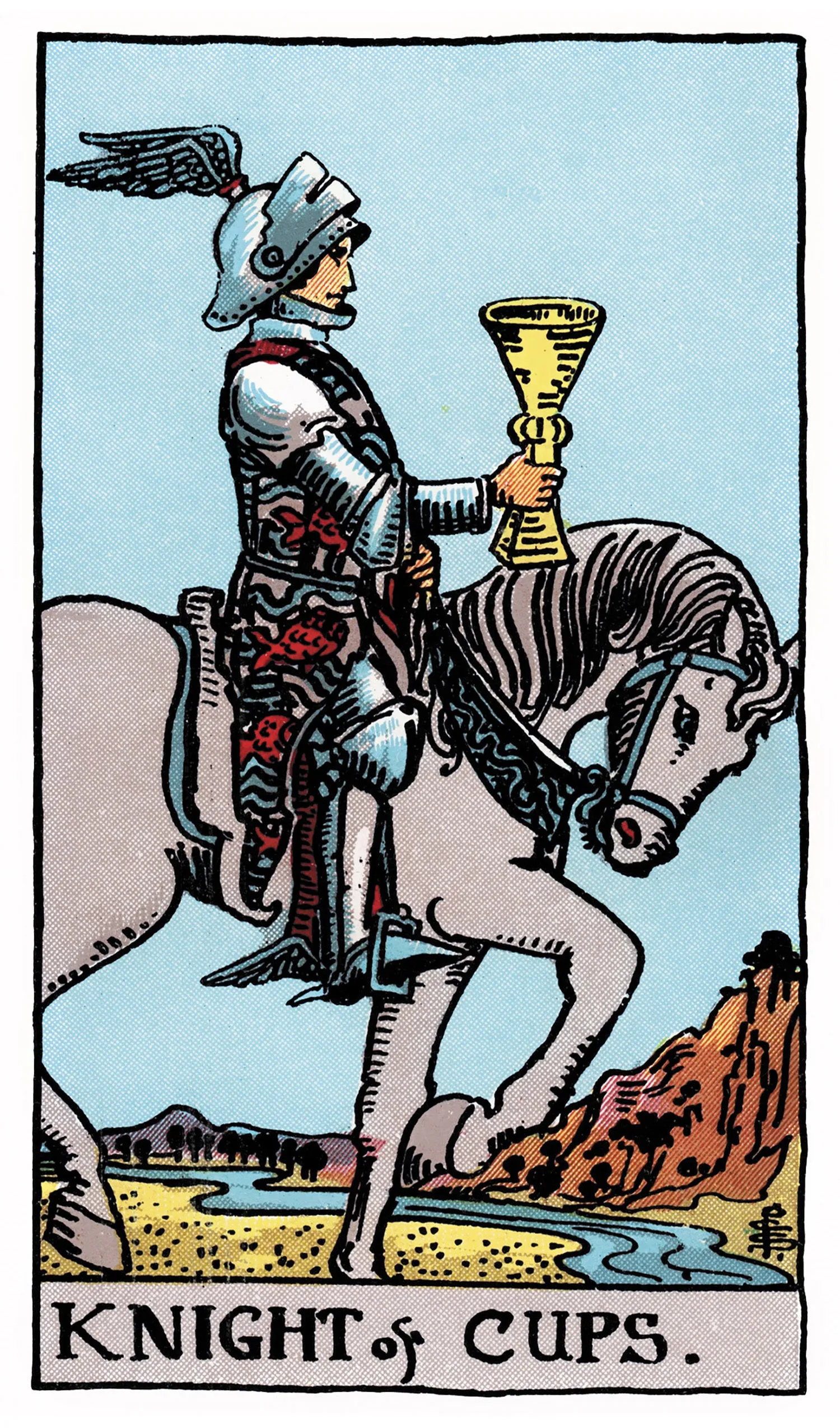
The Knight of Cups Symbolism
The Rider–Waite–Smith Knight of Cups differs noticeably from the more forceful Knights of Wands and Swords.
His horse moves calmly.
The Knight does not charge.
He approaches while carefully carrying the cup in front of him.
The image reinforces the central mechanism of the card: this is still a Knight, therefore there is movement and action, but that movement is governed by Cups — emotion, attraction, imagination, beauty, and relationship.
The Cup
The cup is what the Knight actively carries toward someone or something.
It can symbolize:
- an emotional offer;
- invitation;
- confession;
- proposal;
- message;
- pleasant news;
- reconciliation;
- creative idea.
The Knight does not keep the cup hidden.
He brings it forward.
This is why the card combines information or an offer with active movement.
The White Horse
The white horse gives the Knight movement without the explosive force of the Knight of Wands or the aggressive speed of the Knight of Swords.
His approach is controlled and graceful.
This supports diplomacy, courtship, emotional persuasion, and peaceful approach rather than conquest.
The Knight's Posture
The Knight appears composed rather than combative.
He is not preparing to fight.
His attention is directed toward what he carries and where he is going.
This is a person who wants to reach the other side without destroying the emotional connection in the process.
The River
Water reinforces the emotional nature of the card.
The Knight moves through a world shaped by feelings, impressions, intuition, desire, and imagination.
But Water also explains his vulnerability.
Emotional perception changes.
What feels completely true today may look different once the emotional state changes.
The Winged Helmet and Boots
The wing-like details emphasize imagination, movement, messages, inspiration, and a rich inner world.
The Knight can carry an emotional idea into action.
Yet the same imagination that allows him to create beauty can also carry him away from reality.
The Core Symbolism of The Knight of Cups
The Knight of Cups is the image of emotion becoming active.
He carries a cup rather than a weapon.
He approaches rather than attacks.
He does more than simply announce something: he brings the offer, makes the invitation, initiates the meeting, attempts reconciliation, or moves toward what attracts him.
His greatest strength is his ability to transform emotion into graceful action.
His greatest weakness comes from the same source.
He may become so enchanted by what could be that he fails to see clearly what actually is.