Minor Arcana · Wands · Five
The Five of Wands Tarot Card Meaning
The Five of Wands marks the moment when familiar stability is disturbed and movement begins. It brings tension, competition, experimentation, and change, pushing a person beyond what is comfortable or already known. This card rarely feels easy, but its pressure can force growth, unlock creativity, and reveal new ways forward.
Card Meanings
General Meaning
The Five of Wands represents a disruption of the balance that previously felt stable. After the relative order and security of the Four of Wands, something begins to move again. The old arrangement is no longer enough, and maintaining the same position now requires more effort than before.
This is why the Five of Wands is traditionally associated with competition, disagreement, and struggle. However, conflict is only one expression of a deeper process. The real mechanism of the card is friction created by change.
Several people may want the same position, resource, client, opportunity, or influence. Different opinions may collide. Circumstances may become more demanding. Internally, a person may also experience competing desires, impulses, fears, values, or ideas.
The Five of Wands does not necessarily indicate enemies or serious hostility. Sometimes nobody is deliberately working against you. The difficulty comes from entering an environment where several forces are active at once and where the previous way of functioning no longer guarantees success.
This is an uncomfortable card by nature. Fives disturb equilibrium and begin a new developmental cycle. They require movement, adaptation, and additional effort. A person may need to do something unfamiliar, take a risk, enter competition, learn a new skill, change an established method, or finally confront something they have been avoiding.
Yet the Five of Wands can also be highly creative. Pressure forces experimentation. When the familiar solution no longer works, a person has to invent another one. The card can therefore bring inspiration, new talents, broader thinking, unconventional solutions, and the courage to step beyond familiar limits.
Its purpose is not comfort. Its purpose is development.
At a deeper level, the number Five is connected with established norms, traditions, values, and the principles represented by The Hierophant. In the Five of Wands, those structures are being tested. The person may need to decide which rules still serve a purpose and which have become too restrictive.
Within this interpretive system, Fives may also carry inherited family patterns or unresolved ancestral experience. The person can find themselves confronting struggles, beliefs, or behavioral patterns that existed long before the present situation. The task is not simply to repeat them, but to process them differently and move the pattern forward.
The Shadow Side of The Five of Wands
The difficult side of the Five of Wands appears when challenge stops producing growth and becomes conflict for its own sake.
A person may become excessively competitive, argumentative, provocative, or unable to tolerate situations in which they are not winning. They may turn ordinary differences into battles or unconsciously create opposition because constant resistance has become familiar.
Another shadow expression is activity without direction. A great deal of energy is spent arguing, reacting, comparing, defending, and struggling, but very little actually changes.
The Five of Wands can also show a person who needs constant stimulation and therefore finds stability boring. Instead of allowing something to develop peacefully, they may create unnecessary complications simply to feel movement.
The Five of Wands Reversed
The reversed Five of Wands shows the same process of tension and disrupted balance, but functioning poorly.
The need for change remains, yet the person may be unable to transform the pressure into constructive movement. Competition becomes chaotic or unfair, arguments become repetitive, and enormous amounts of energy may be spent without producing meaningful progress.
This can manifest as sabotage, destructive criticism, dirty tactics, hostile rivalry, lack of cooperation, or people trying to win through methods that damage the situation itself.
A person may resist a necessary transition, repeatedly return to the same conflict, fight in too many directions at once, or continue trying to restore an old balance that can no longer be maintained.
The reversed card can also show exhaustion from prolonged competition. The struggle has become more costly than the possible reward.
Rather than indicating that conflict has simply disappeared, the reversed Five of Wands often suggests that the tension is no longer helping the person develop.
Core Message
The Five of Wands appears when remaining exactly where you are is no longer possible.
Growth now requires effort, experimentation, courage, and a willingness to tolerate temporary discomfort. The challenge is not merely to fight harder, but to discover a better way of moving forward.
The Five of Wands does not promise comfort. It promises movement.
The Five of Wands as a Person
The Five of Wands can describe an energetic, competitive, restless, and highly responsive person who develops through challenge.
They often perform well when circumstances demand quick thinking, adaptation, or creative problem-solving. Competition can motivate them. Obstacles may activate abilities that remain dormant in calmer conditions.
This person may also be a natural innovator. They do not always accept established methods simply because those methods are traditional. When something stops working, their instinct is often to experiment, test alternatives, or find an entirely different approach.
They can broaden other people's thinking and introduce movement into environments that have become stagnant.
However, the tension of the Five of Wands may exist just as strongly inside the person as outside them. They can experience conflicting desires, ambitions, values, or impulses and may struggle to decide which part of themselves should lead.
At times, excessive competitiveness can also be driven by a fear of being overlooked, underestimated, displaced, or losing their place. The need to prove themselves may become stronger when they feel that recognition is uncertain.
They are not always easy to be around. Their inner tension can spill outward. They may argue readily, challenge other people's opinions, become impatient with passivity, or treat situations as competitions even when nobody else sees them that way.
The Five of Wands as Actions
As actions, the Five of Wands means entering the struggle rather than remaining passive.
The person may compete, argue their position, defend an idea, participate in a contest, test themselves against others, challenge an established method, or attempt several different approaches until something works.
They may deliberately push beyond familiar limits and accept temporary discomfort in order to achieve a better result.
The card can also indicate brainstorming, experimentation, active debate, training, testing, or learning through direct experience.
The Five of Wands in Love and Relationships
In relationships, the Five of Wands usually brings tension rather than emotional peace.
Partners may argue, compete for influence, challenge one another, or struggle over whose needs, opinions, priorities, or boundaries will determine the direction of the relationship.
The card may appear when two strong personalities are learning how to coexist without turning every disagreement into a contest.
It can also indicate external competition around the relationship, including several people seeking someone's attention. However, the Five of Wands does not automatically mean a love triangle or infidelity. Competition must be supported by the question and surrounding cards.
The card can also bring strong physical or sexual activation. Attraction may feel exciting precisely because the connection is difficult, competitive, provocative, or not fully available. In some cases, sexual energy is present but does not find easy or satisfying expression, increasing tension rather than creating closeness.
In some relationships, the friction is productive. Partners challenge each other, stimulate growth, introduce new experiences, or prevent the connection from becoming stagnant.
But this is not naturally a peaceful relationship card. Even when attraction is present, something requires effort.
The Five of Wands as Thoughts
As thoughts, the Five of Wands shows that a person sees the situation as competitive, complicated, or requiring effort.
They may believe they need to fight for attention, defend their position, outperform somebody else, prove themselves, or find a strategy that gives them an advantage.
They can also be mentally testing possibilities, comparing different approaches, or questioning an established way of doing things.
Their mind is active, but not peaceful.
The Five of Wands as Feelings
The Five of Wands is not a particularly strong card of deep emotional attachment.
It can show excitement, irritation, jealousy, competitive attraction, sexual tension, emotional stimulation, or the desire to win someone's attention.
The person may feel strongly activated by the connection without necessarily experiencing calm, secure, or deeply affectionate love.
Sometimes the attraction itself is intensified because the situation is difficult or because another person is perceived as a challenge.
The card can also indicate unfulfilled sexual tension: desire is present, but the interaction does not provide an easy sense of satisfaction. Attraction and frustration may therefore exist at the same time.
The Five of Wands as Intentions
As intentions, the Five of Wands indicates a willingness to compete, fight for a position, test the situation, or make an active effort.
The person does not intend to remain passive. They may want to prove themselves, win attention, challenge the current dynamic, or see how far the connection can be pushed.
Their intentions can also involve changing the existing pattern rather than accepting things as they are.
The Five of Wands as an Outcome
As an outcome, the Five of Wands usually shows that the situation has not yet reached peaceful resolution.
Movement occurs, but through competition, effort, disagreement, experimentation, or challenge. Different forces are still interacting, so the final position may remain unsettled.
The card can indicate progress if the question involves training, competition, testing, creative development, or breaking out of stagnation. However, it does not promise an easy victory.
The person reaches a stage where they must become stronger, more flexible, or more inventive in order to continue.
The Five of Wands in Career and Work
Career is one of the most natural areas for the Five of Wands.
It can indicate professional competition, several people applying for the same position, competing businesses, rival ideas, difficult negotiations, internal disagreements, performance comparisons, contests, pitches, or the need to prove professional ability.
The environment may be demanding, but it can also be highly developmental.
The Five of Wands often appears when a person has outgrown an old professional method and needs to experiment. It favors brainstorming, testing, innovation, and learning through challenge.
A difficult colleague, ambitious competitor, demanding market, or changing industry may force the person to become better than they were before.
The card is also strongly connected with training and the testing of skills. It can appear around examinations, professional assessments, auditions, competitions, practical training, trial tasks, interviews, or situations in which a person's ability must be demonstrated against an external standard or compared with other candidates.
In this sense, the Five of Wands is not only about defeating other people. It can show the process through which ability is sharpened because it is being tested.
The card does not guarantee professional victory. It shows that there is something worth competing for and that passive behavior is unlikely to be enough.
The Five of Wands in Money and Finances
Financially, the Five of Wands is not a card of effortless stability or automatic wealth.
Money, resources, clients, contracts, or opportunities may need to be actively pursued. Several people may be competing for the same source of income, and the person may need to work harder than usual to protect or improve their financial position.
It can also show a period when circumstances are changing and old financial methods are no longer sufficient.
The constructive expression of the card is adaptation: trying another strategy, developing a new skill, competing more effectively, or finding a creative way to improve income.
The card does not itself promise abundance, luxury, or secure profit. It shows competition for material resources, and the final financial result depends on whether that competition is successfully navigated.
The Five of Wands in Health
Within this Tarot health system, the Five of Wands represents the theme of internal struggle.
Upright, it may symbolically correspond with periods of increased physical stress, inflammatory processes, fever, exacerbation of an existing condition, or minor injuries. The card is also associated within this system with lipid metabolism and a predisposition toward atherosclerotic processes.
The central Tarot image is one of the organism having to expend energy in order to resist or manage something.
Tarot should not be used as a substitute for medical diagnosis or treatment.
The Five of Wands Timing — When Will It Happen?
The Five of Wands usually indicates relatively fast movement.
Events tend to develop within approximately one week to one month. The process may not be smooth, but once the situation becomes active, it rarely remains completely static.
Key Timing Correspondence
Approximately one week to one month.
The Five of Wands usually brings movement quickly, although the period itself may involve several attempts, obstacles, disagreements, or competing factors before the situation develops fully.
The Five of Wands as an Event
As an event, the Five of Wands can indicate a competition, contest, debate, disagreement, examination, audition, test, training session, negotiation, confrontation, or any situation in which several people or forces are trying to influence the same outcome.
It can also describe entering a new environment where the person must prove themselves.
Sometimes the event is less literal: circumstances become more demanding, the previous routine stops working, and a person is forced to experiment with a new approach.
The common denominator is that the situation becomes active and requires participation.
The Five of Wands as Card of the Day
The Five of Wands suggests an active, demanding day.
Plans may require more effort than expected. Other people may disagree with you, several tasks may compete for attention, or you may find yourself in a situation where you have to react quickly and adapt.
The best use of the day is to treat resistance as information. Instead of immediately becoming frustrated, notice what the challenge is forcing you to learn or change.
This can be an excellent day for brainstorming, experimentation, sport, competition, training, studying under pressure, or testing an idea in real conditions.
The Five of Wands as Advice
The Five of Wands advises you to accept that some degree of struggle is currently necessary.
Do not expect the situation to improve while you remain completely inside your comfort zone. Compete where competition is unavoidable, defend what matters, test yourself, and be prepared to put in additional effort.
At the same time, do not simply fight harder.
Change your approach.
Experiment. Look for a solution that has not been tried before. Challenge an outdated method. Allow the pressure of the situation to activate abilities that ordinary stability would never require you to use.
Temporary discomfort may be the price of moving to the next level.
The Five of Wands Reversed as Advice
Do not waste your remaining strength on a struggle that has stopped producing progress.
Reduce unnecessary conflict, stop trying to win every argument, and examine where your energy is actually going.
Do not lower yourself to sabotage, dirty tactics, or destructive competition simply because other people are doing so.
The problem may not be that you are failing to fight hard enough. You may be fighting in the wrong way, against the wrong obstacle, or for something that no longer justifies the cost.
Protect your resources and look for a more intelligent route forward.
The Five of Wands as a Warning
The Five of Wands warns against confusing constant activity with real progress.
Competition can help you grow, but it can also become addictive. Do not turn every disagreement into a battle, create rivals where none exist, or exhaust yourself proving that you are stronger, smarter, or more deserving than somebody else.
Another danger is resisting change while believing you are fighting for stability. Sometimes the thing you are trying to preserve has already completed its purpose.
The card also warns that talent alone is not enough. Without direction, creative energy can scatter into dozens of unfinished attempts.
The Five of Wands — Yes or No
Upright: Yes, but it will be difficult
The answer is yes, but the result will require effort.
Expect competition, resistance, complications, or the need to prove yourself. The possibility exists, but it is not being offered easily.
You will probably need to push beyond your normal comfort zone and actively participate in creating the result.
Reversed: No
The answer is no under the current conditions.
Too much energy is likely to be consumed by struggle without enough return. Rather than forcing the situation harder, it is better to conserve your strength and reconsider where your effort will be more useful.
The Five of Wands Symbolism
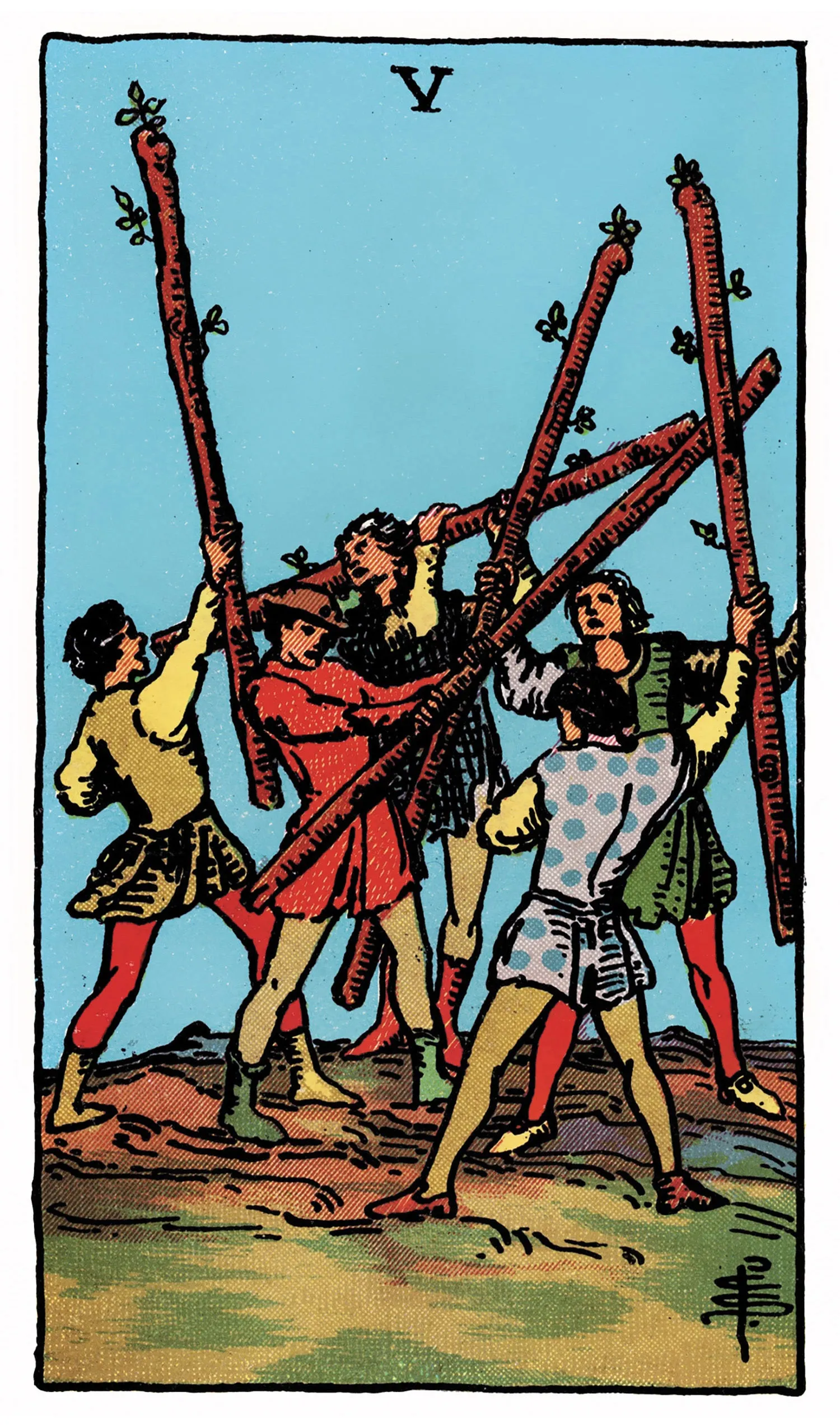
The Rider–Waite–Smith Five of Wands shows five figures raising wooden staffs in what appears to be a chaotic struggle. It is difficult to determine whether they are truly fighting, training, competing, or simply testing one another.
That ambiguity is central to the card.
Not every struggle is an attack. Some forms of resistance exist to strengthen ability, test limits, and reveal what still needs development.
The Five Figures
No single person clearly controls the scene.
Each figure is acting independently, creating a situation in which several intentions exist at once. This reflects competition, conflicting priorities, disagreement, and the difficulty of creating order when everyone is trying to move in a different direction.
It also explains why the Five of Wands is different from the Seven of Wands.
In the Seven, one person defends a defined position against outside pressure. In the Five, everyone is still inside the contest. The hierarchy has not yet been established.
The Raised Wands
The wands are active rather than planted firmly in the ground.
They represent energy that has been released but not yet organized into a stable structure. Desire, initiative, creativity, and ambition are present, but they are colliding rather than moving in one coordinated direction.
This is why the card can indicate both conflict and creativity.
The same energetic pressure that produces disagreement can also produce new ideas.
The Lack of a Clear Winner
There is no obvious victor.
The Five of Wands therefore describes the process of competition rather than guaranteed victory or defeat.
The result is still being formed.
The person is being tested through participation, and the experience itself may change their skills, strategy, confidence, or direction before the final outcome is known.
The Number Five and The Hierophant
Five disturbs the stability created by Four.
Where Four establishes a structure, Five tests whether that structure can survive movement and change.
In this system, the number Five is also connected with The Hierophant and therefore with traditions, inherited rules, moral systems, social norms, and established ways of doing things.
The Five of Wands may therefore challenge a person to question an old approach rather than follow it automatically.
At a deeper level, the Fives can also carry inherited family patterns. Old conflicts, beliefs, survival strategies, and generational habits may reappear so that they can be processed differently rather than unconsciously repeated.
The Core Symbolism of The Five of Wands
The Five of Wands shows energy breaking out of an established structure before a new structure has been created.
The scene is uncomfortable because several forces are active simultaneously and none has yet produced order.
Yet this disorder has a purpose.
The card represents the stage where growth requires friction. Old methods are tested, abilities are challenged, and the person is pushed to discover what they can do when the familiar solution is no longer enough.
Its central visual message is therefore not simply conflict.
It is development through resistance.