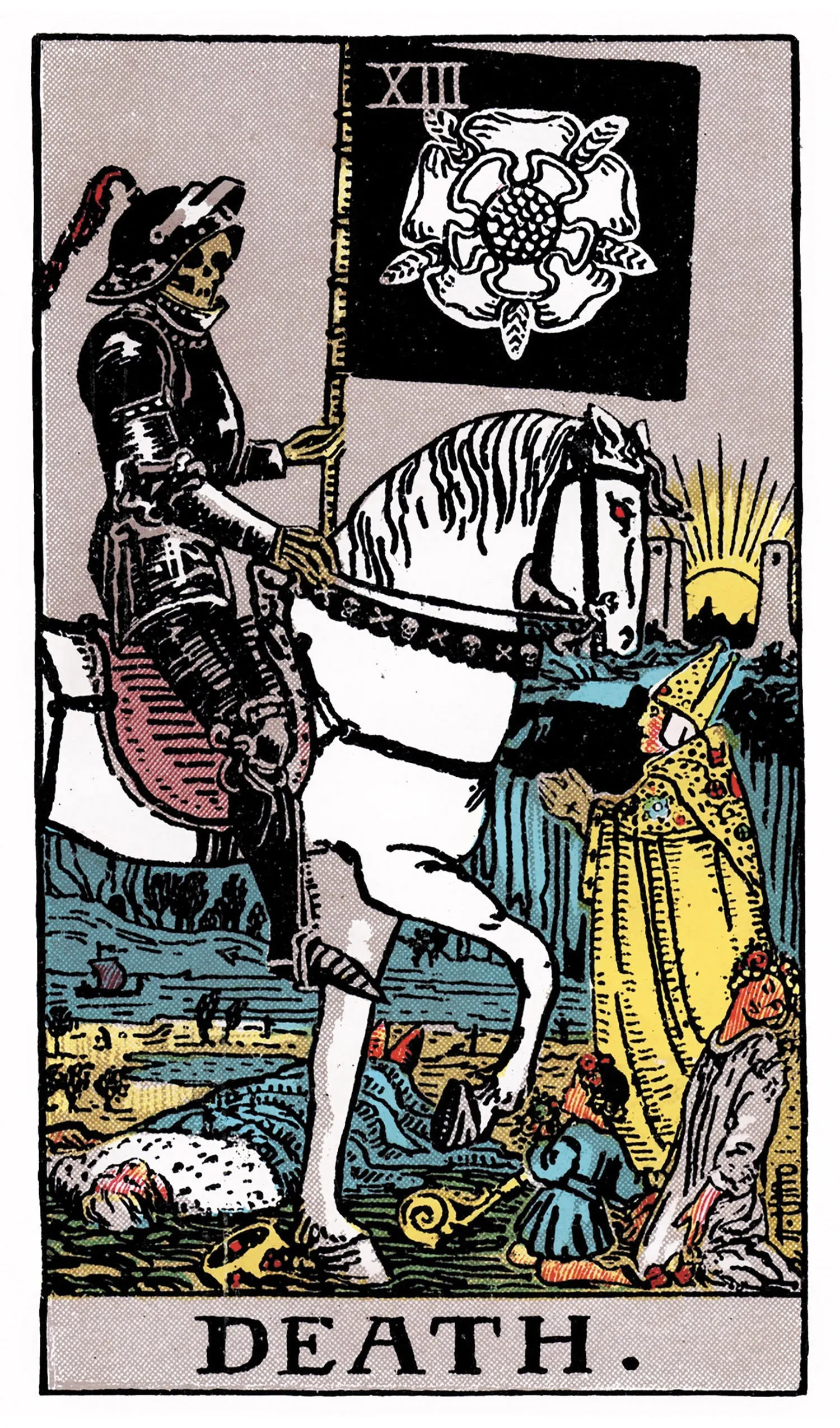
Major Arcana · Card XIII
Death Tarot Card Meaning
Death is the card of endings, irreversible transition, and radical change. It shows that something has reached the point where it can no longer continue in its existing form: a stage closes, an attachment is severed, an old structure disappears, and the situation moves into a fundamentally different state.
Despite its dramatic imagery, Death does not automatically predict tragedy or literal death. Its central principle is the end of the old form. Whether that ending ultimately becomes beneficial, painful, liberating, or destructive depends on what is ending and what the surrounding cards show next.
Death creates the break between one stage and another, but it does not guarantee that the next stage will be better. The change may manifest suddenly and radically even when the process leading toward it has been developing for a long time.
Card Meanings
General Meaning
Death represents a point of no return. Something has reached the end of its current life cycle and can no longer remain exactly as it was. A relationship may end, a job may disappear, a project may be closed, an old identity may become impossible to maintain, or circumstances may shift so substantially that returning to the previous situation is no longer realistic.
The card is therefore stronger than ordinary change. Many Tarot cards can describe movement, adjustment, or development; Death describes a fundamental break with the previous state.
The final event may appear sudden, sharp, or dramatic, although the conditions that produced it may have been developing for some time. A breakup may happen in one conversation after months of deterioration. A person may resign in one day after years of dissatisfaction. A project may close abruptly after a long period of declining viability.
This is why Death can be experienced very differently depending on the question. If the current situation is painful or limiting, its ending may be necessary and ultimately relieving. If the person is strongly attached to what exists now, the same card can feel severe and destabilizing.
Death should not automatically be interpreted as renewal, rebirth, healing, or a wonderful new beginning. A new stage becomes possible because the previous one ends, but Death itself does not describe the quality of what follows. That must be established from the rest of the spread.
The Shadow Side of Death
The difficult side of Death is its severity and irreversibility.
It can show a tendency to cut people or situations off completely, destroy what might still have been repaired, or make radical decisions with little softness or compromise. The person may become cold, abrupt, uncompromising, or excessively focused on eliminating whatever they believe has reached its end.
Death can also show fear of loss and the pain created by trying to preserve something whose natural cycle has already finished.
At its harshest, the card becomes destructive rather than transformative: instead of removing only what has genuinely expired, a person may tear down far more than necessary.
Death Reversed
Death reversed shows the same process of ending and transition functioning badly.
The old stage is already exhausted, but the person or situation cannot complete the transition properly. Something that should have ended is prolonged, closure is repeatedly postponed, and the person remains caught between a past that no longer works and a future that cannot properly begin.
It may manifest as resistance to an inevitable ending, repeated attempts to revive something that has already run its course, prolonged deterioration, or a painful transition made worse because the necessary break is avoided.
In some situations, the distortion can move in the opposite direction: instead of refusing to cut anything off, the person may try to cut off the wrong thing, destroying something that has not actually reached its natural end.
The reversed card does not restore the old situation. It shows that the process of ending has become more difficult, more distorted, more prolonged, or poorly directed.
Core Message
Something has reached the end of its existing form.
Do not confuse preserving the familiar with preserving something that still has a future.
Death marks the boundary after which the situation cannot honestly continue as before.
Death as a Person
As a person, Death often describes someone independent, severe, sharp, and psychologically difficult to influence.
This person may be highly self-contained and emotionally detached from other people's expectations. They are often capable of making radical decisions and severing ties with the past far more easily than others expect.
When they decide that a stage is finished, they may leave a job, relationship, social circle, lifestyle, or identity behind with surprising finality.
There can be something abrupt or uncomfortable about their communication style. They may speak sharply, reject social niceties they consider unnecessary, say unpleasant truths directly, or create an atmosphere in which other people feel that warmth and compromise are limited.
Such a person can be difficult or simply unpleasant to communicate with, especially when their directness turns into coldness, harshness, or emotional distance.
At the same time, Death can give strong psychological insight. This person may notice when a relationship, project, or situation has already exhausted itself before other people are willing to admit it. They can see where events are heading and recognize an inevitable ending early.
Their strength is the ability to accept finality and move forward.
Their weakness is the tendency to become too severe, detached, uncompromising, or destructive in the process.
Death as Actions
As actions, Death is direct and final.
A person ends something, cuts contact, resigns, closes a project, leaves, removes an option, abandons an old plan, gets rid of what is no longer needed, or makes a decision that fundamentally changes the situation.
These actions are rarely minor adjustments. Death tends to remove the existing structure rather than improve it gradually.
The action itself may be very sudden even when the decision has been developing internally for a long time.
Death in Love and Relationships
In relationships, Death most often indicates the ending of the relationship or the ending of the emotional bond that previously held it together.
This is one of the stronger cards of breakup, separation, divorce, emotional closure, and a relationship reaching the point beyond which it cannot continue as before.
The connection may have been deteriorating for a long time, but Death often shows the point at which the accumulated process becomes final: one person leaves, a decisive conversation happens, contact ends, or the relationship changes so radically that its previous form is effectively gone.
Although Death can occasionally describe a profound transformation within an existing relationship, this should not automatically be used to soften the card. In practice, especially when the surrounding cards do not support continuation, Death more often points toward an actual ending.
In a relationship that remains formally intact, the card can also show that the feelings or dynamic that once defined it have already died. The people may still be together while the relationship itself exists more as a form than as a living emotional connection.
For a new connection, Death can appear when an old relationship or emotional chapter must first be closed before another can genuinely begin.
Death as Thoughts
In thoughts, Death often appears as the realization:
“This cannot continue.”
The person may be thinking seriously about ending the relationship, breaking contact, leaving, changing the entire structure of the connection, or accepting that there is no realistic way to restore what existed before.
Their thinking is focused less on repairing small details and more on whether the relationship itself still has a future.
Death as Feelings
As feelings, Death often shows that the previous emotional state is dying or has already changed irreversibly.
Feelings may be fading, attachment may be weakening, emotional involvement may be shutting down, or the person may feel that they have reached the end of what they were capable of feeling within this relationship.
In some cases, strong feelings remain, but they are connected more with grief, loss, resentment, or the pain of an ending than with a living romantic bond.
Death is not naturally a card of warmth, tenderness, or continuing emotional attachment.
Death as Intentions
As intentions, Death indicates a desire to end the current situation or change it decisively.
The person may intend to break up, leave, close the subject, cut contact, remove an old relationship pattern, or make a decision that eliminates the possibility of returning to the previous state.
This is rarely an intention to preserve everything exactly as it is.
Death as an Outcome
As an outcome, Death shows the end of the situation in its current form.
The existing arrangement, relationship, project, plan, stage, or pattern reaches a point where it cannot continue unchanged. Something closes, is abandoned, disappears, or becomes fundamentally different.
This makes Death a strong card of finality.
If the question asks whether the current situation will continue in the same direction, Death usually indicates that it will not.
The ending itself can be sudden and decisive even when the process leading toward it has been developing for a long time.
Death is not automatically a negative outcome. If the question concerns escaping an unhealthy situation, ending a prolonged problem, or leaving behind something obsolete, the ending may be necessary.
At the same time, Death does not guarantee that what comes next will be successful.
Its message is the end of the previous form, not the quality of the future.
Death in Career and Work
In career matters, Death frequently shows the end of a professional stage.
This can manifest as resignation, dismissal, closure of a business or project, restructuring, the end of a professional partnership, a radical change of profession, or the disappearance of an old way of working.
Death can also identify a nonviable project or idea.
The project may still technically exist, money and effort may continue to be invested in it, but there is no real organic development. In this sense, Death can show an idea that has no future in its current form, a project that has exhausted its potential, or something that should be closed instead of being kept artificially alive.
Sometimes the ending looks sudden — a company closes, a person is dismissed, a partnership breaks apart — while in reality the underlying problems have been accumulating for a long time.
If the question concerns whether the current professional situation will remain stable, Death usually suggests substantial change or closure.
The card can be constructive when the existing career path has already reached its limit, but another card is needed to show whether the next professional direction will actually be better.
Death in Money and Finances
In finances, Death represents the ending of an existing financial structure.
An income source may disappear, employment may end, a financial arrangement may collapse, spending priorities may change radically, assets may be sold, obligations may be closed, or the person may be forced to rebuild their financial system from a different starting point.
Loss of a source of income is therefore one of the card's possible direct manifestations.
The card can also show that old methods of earning, saving, investing, or managing money have become obsolete and can no longer produce the previous result.
Death does not automatically mean poverty or financial ruin. In some contexts, it can represent the ending of a difficult financial period.
However, it should not be softened into a generic promise of improvement. The card first shows the ending of the existing financial model. What replaces it must be judged separately.
Death in Health
In the Tarovera Tarot health system, Death indicates a variable or unstable condition rather than automatically indicating literal death.
On its own, the card should not be interpreted as proof that someone will die.
A mortality-related interpretation would require a much broader and significantly more negative combination of cards, and the person's age and overall condition must also be considered.
For a younger person especially, Death alone is far more likely to describe instability or a significant change in condition than literal mortality.
Tarot should not be used as a substitute for medical diagnosis or treatment.
Death Timing — When Will It Happen?
Death does not provide a reliable numerical answer to questions such as “How many days?”, “How many weeks?”, or “How many months?”
For the question “When?”, its primary correspondence is the end of October through the beginning of November.
For the question “How soon?” or “In how much time?”, Death is better understood through the nature of the event itself.
The event tends to happen suddenly, at the moment when the existing situation reaches a decisive breaking point.
The process leading toward that moment may have been developing for a long time, but the actual transition can occur abruptly.
Key Timing Correspondence
When: Late October / early November.
How soon: No reliable numerical interval. The event is more likely to happen suddenly, at the moment of a decisive and irreversible change.
Death as an Event
As an event, Death is one of the clearest cards of radical, sharp, and irreversible change.
Something can end suddenly, circumstances can change dramatically, or an event can occur that makes it impossible to return to the previous situation.
Possible manifestations include a breakup, divorce, resignation, dismissal, closure of a project or business, the end of a partnership, relocation, abandonment of an old lifestyle, or another major turning point that divides events into a clear before and after.
The visible event may be abrupt even when the situation has been moving toward it for some time.
Death therefore often describes the moment when a long-developing process finally reaches its breaking point.
The essential feature is not necessarily catastrophe.
It is cardinality, finality, and irreversible change.
Death as Card of the Day
As Card of the Day, Death suggests that something may finish, be removed, or change more radically than expected.
A plan can be cancelled, an old issue can finally close, a decision can become irreversible, contact can end, or circumstances may suddenly shift direction.
The card can also show a day when you clearly realize that something you have been maintaining no longer has a future.
Pay attention to what has genuinely reached the end of its usefulness rather than automatically trying to preserve it.
Death as Advice
Death advises you to stop something decisively.
Do not keep repairing, feeding, repeating, or maintaining a process simply because it once mattered.
If the situation has reached its natural end, close it.
This may require a hard and sudden decision: end contact, stop the behavior, abandon the obsolete plan, leave the exhausted situation, close the project, remove what is no longer working, or draw a clear line that prevents a return to the old pattern.
Death is not advice to make endless gradual adjustments when the real problem is that the entire structure needs to end.
Sometimes the correct action is not to improve something.
It is to stop doing it altogether.
Death Reversed as Advice
Stop prolonging an ending you already know is necessary.
Half-measures, repeated returns, and attempts to preserve pieces of an exhausted situation can make the transition more painful.
Identify what genuinely needs to end and complete the separation properly.
At the same time, make sure you are cutting away the right thing. A distorted Death can destroy what still has life while leaving the actual problem untouched.
Death as a Warning
Death warns that some decisions are irreversible.
A radical cut may be necessary, but destroying everything in a moment of anger, impatience, or emotional extremity can remove things that did not actually need to be lost.
Before closing a door permanently, make sure you understand what exactly has reached its end.
The card can also warn that a situation has already crossed the point where small cosmetic changes will be enough.
Ignoring that fact may allow the eventual ending to become harsher.
Death — Yes or No
Upright: No
Death usually gives a No when the question assumes that the existing situation will continue, remain unchanged, or develop in its current form.
The card indicates an ending, severance, or fundamental transformation rather than preservation of the status quo.
If the question itself asks whether something will end, be closed, removed, or radically changed, Death can naturally confirm that it will.
Reversed: No
Reversed Death remains a No.
The necessary ending or transition may be delayed, resisted, distorted, or prolonged, but the old situation does not regain genuine viability simply because the transition has stalled.
Death Symbolism
The Rider–Waite–Smith image presents Death not as a private emotional experience but as a force moving through an entire landscape.
No rank, age, or social position is exempt from the transition it represents.
The Skeleton
The skeletal figure strips life down to what cannot be negotiated away.
A skeleton has no social identity, profession, status, beauty, or personal history. Symbolically, this reinforces the card's association with endings that reach beneath superficial adjustments and affect the underlying structure itself.
The Black Armor
The dark armor gives the rider an impersonal and unstoppable quality.
Death is not shown debating whether change should occur. The image suggests a process that continues regardless of whether the people involved welcome it.
The White Horse
The white horse moves steadily forward.
Its brightness contrasts with the rider's dark armor, suggesting that an ending is not automatically equivalent to evil or destruction for its own sake.
Something is being carried from one state into another.
The White Rose Banner
The black banner bears a white rose, combining the imagery of ending with continuity.
The symbol does not promise that the future will be pleasant. Rather, it suggests that existence continues beyond the form that has ended.
The Fallen King
The king lying beneath the horse makes one of the card's central ideas unmistakable: status cannot protect an exhausted cycle from ending.
What has reached its limit ends regardless of how powerful, established, or important it once appeared.
The Bishop, Woman, and Child
The figures respond differently to the rider.
Some resist, some plead, some turn away, while the child appears comparatively open.
Their different reactions illustrate how the same unavoidable transition can be met with fear, bargaining, grief, resistance, or acceptance.
The Rising Sun Between the Towers
In the distance, the sun appears between two towers.
This does not erase the ending occurring in the foreground.
Instead, it places the ending inside a larger sequence: the current stage closes while existence continues beyond it.
The important distinction is that the sunrise represents possibility after the ending, not a guarantee that Death itself provides a successful new beginning.
The River and Boat
The water and boat reinforce movement from one state to another.
The landscape does not remain fixed. Something is being carried onward, supporting the card's central theme of crossing a boundary that cannot simply be uncrossed.
The Core Symbolism of Death
The imagery of Death combines finality, inevitability, severity, and movement.
The skeletal rider advances while figures from different levels of society react to what cannot be stopped. Behind them, the landscape continues toward another horizon.
The central visual message is not simply mortality.
It is that forms end, stages close, and life moves beyond structures that can no longer continue.