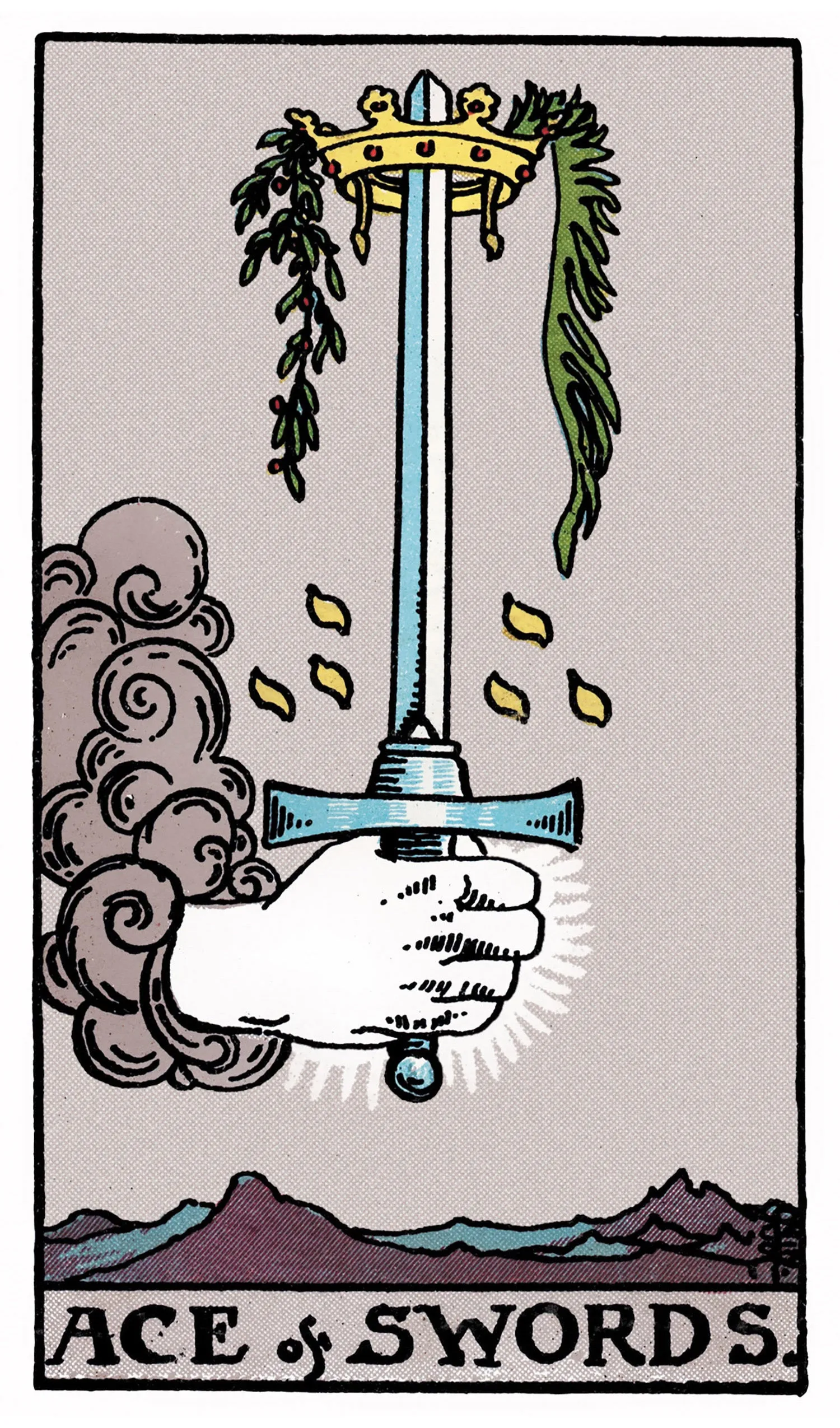
Minor Arcana · Swords · Ace
The Ace of Swords Tarot Card Meaning
The Ace of Swords represents a breakthrough in understanding, the arrival of truth, and the determination to act on what has become clear. It is the moment when confusion is cut away, the central issue is identified, and a decision becomes possible.
This card combines mental clarity with force of will. It does not merely say, “I understand.” It says, “I understand what must be done, and I am ready to draw the line.”
Like every Ace, it opens a powerful new direction rather than guaranteeing the entire result that follows.
Card Meanings
General Meaning
The Ace of Swords appears when a situation becomes clear enough to make a decision.
Something that was vague, confusing, hidden, or difficult to define can suddenly be understood. New information may arrive. A person may finally recognize what is really happening, identify the central problem, formulate an answer, or decide what must happen next.
This is more than an interesting new thought.
The sword separates one thing from another. It distinguishes fact from assumption, the essential from the irrelevant, what should continue from what needs to be cut away.
For this reason, the Ace of Swords is strongly associated with truth, logic, conclusions, communication, documents, analysis, decisions, boundaries, intellectual work, and situations that require a definite answer.
But clarity alone is only part of the card.
The Ace of Swords also contains will.
Once the person understands the situation, they are prepared to do something with that understanding. They may speak directly, make a decision, set a boundary, eliminate an obstacle, defend a position, solve a problem, or begin a new course of action.
The card therefore follows a clear internal sequence:
clarity → decision → determination → cutting through uncertainty → a new direction.
The Ace of Swords can be a card of victory, particularly where success depends on intelligence, strategy, argument, courage, or decisive action. It may show winning a debate, passing an intellectual challenge, solving a difficult problem, gaining approval, or overcoming an obstacle through superior judgment.
However, it should not be turned into a universal promise of success.
A clear decision is not the same as a completed result. A good strategy still has to be implemented. A new idea still needs development. A difficult truth may solve uncertainty while creating an uncomfortable new reality.
Sometimes the card brings exactly the answer a person hoped for.
Sometimes it brings the answer they needed but did not want.
Its fundamental gift is not comfort.
It is the ability to see clearly enough to stop living inside uncertainty.
The Shadow Side of The Ace of Swords
The Ace of Swords becomes difficult when mental clarity turns into excessive certainty.
A person may believe that because their reasoning appears logical, their conclusion must automatically be correct. They can become impatient with nuance, emotion, uncertainty, or information that does not fit the conclusion they have already reached.
Directness can become cruelty.
Determination can become aggression.
A healthy boundary can become an unnecessary ultimatum.
The desire to solve the problem can become the desire to cut through everything standing in the way, including things that did not actually need to be destroyed.
The card can also produce intellectual competitiveness. Instead of using intelligence to understand the situation, a person uses it to win, dominate, expose weaknesses, or prove another person wrong.
Another shadow is premature finality.
The person wants a clear answer so badly that they force one before enough information exists.
The strength of the sword lies in precision.
Without precision, the same blade that solves the problem can create another one.
The Ace of Swords Reversed
The reversed Ace of Swords shows the upright principle becoming weakened, distorted, blocked, premature, or badly applied.
One manifestation is lack of clarity.
The person may misunderstand the situation, receive incomplete information, draw the wrong conclusion, fail to identify the real problem, or become mentally overwhelmed by conflicting facts and interpretations.
Another manifestation is lack of decisiveness.
The person may know that a decision has to be made but continue avoiding it. They think, discuss, analyze, and reconsider without ever reaching the point where anything actually changes.
This can create endless conversations that produce no result.
Words are exchanged, explanations are given, the same subject is discussed repeatedly — yet nobody makes the decision that would move the situation forward.
The reversed Ace can also indicate an unwillingness to accept information. The truth may already be visible, but the person rejects it, argues against it, or remains attached to the conclusion they prefer.
In another deterioration, the sword becomes too forceful.
The person makes a premature decision, speaks aggressively, starts a confrontation, or acts as if absolute certainty exists where it does not.
The card can also show starting too early: the idea may be real, but the plan is not sufficiently developed, the information is incomplete, or the conditions required for successful implementation do not yet exist.
The reversed Ace of Swords therefore can mean:
- failing to understand;
- refusing to understand;
- understanding but failing to decide;
- deciding incorrectly;
- deciding too quickly;
- talking without changing anything;
- acting before the idea or situation is ready;
- using intelligence or communication destructively.
It is not simply the opposite of clarity.
It is the sword functioning badly.
Core Message
See what is actually happening.
Find the central issue.
Make the decision that follows from the facts.
Then have the courage to act on it.
The Ace of Swords gives clarity and the power to draw a line. What happens next depends on whether the sword is used with precision rather than force alone.
The Ace of Swords as a Person
The Ace of Swords as a person describes someone intelligent, mentally quick, observant, direct, and decisive.
This person wants to understand how things really work. They notice contradictions, ask precise questions, analyze information quickly, and often identify the central problem before other people do.
They usually prefer clear communication over hints, ambiguity, or emotional guessing games.
They can be talented in areas that require analytical ability, strategy, research, writing, law, negotiation, technology, management, problem-solving, or intellectual competition.
There is also a strong-willed quality to this personality.
Once they have reached a conclusion, they tend to act on it. They can set boundaries, defend a position, make difficult decisions, and remove obstacles without spending excessive time looking backward.
At their best, they are intelligent, honest, focused, courageous, and capable of bringing order to complicated situations.
At their worst, they can become severe, impatient, argumentative, dismissive of emotion, or too certain that their own reasoning represents objective truth.
The Ace of Swords as Actions
As actions, the Ace of Swords is direct and decisive.
The person seeks the facts, asks the question, starts the conversation, states their position, makes the decision, establishes a boundary, prepares the document, develops a strategy, or removes something that is preventing progress.
They do not want the situation to remain undefined indefinitely.
Typical manifestations include:
- speaking honestly;
- requesting a clear answer;
- making a firm decision;
- defining terms and boundaries;
- researching and analyzing;
- solving a problem;
- signing or preparing important documents;
- defending a position;
- cutting unnecessary obligations;
- choosing between alternatives;
- starting a new intellectual project;
- confronting an issue that has been avoided.
There may also be a competitive element.
If the situation requires argument, strategy, courage, or mental strength, the person is prepared to fight for the result.
The Ace of Swords in Love and Relationships
The Ace of Swords in relationships represents clarity, an honest conversation, truth without sugarcoating, and a new stage based on logic rather than illusion.
It often appears when ambiguity can no longer continue.
Two people may finally discuss what is actually happening between them, define the relationship, reveal important information, ask a difficult question, establish boundaries, or make a decision about what comes next.
The card removes fantasy.
What one person hoped, assumed, imagined, or avoided has to be compared with reality.
For an existing relationship, this can be highly constructive. A difficult but honest conversation may solve a problem that could not be resolved while both people were avoiding the truth.
The relationship may enter a new stage because both people finally understand what they are dealing with.
However, the new stage is not automatically romantic or comfortable.
The truth may show that the relationship can continue under clearer conditions.
It may also show that something must change, that a boundary must be established, or that the current form of the relationship no longer makes sense.
For a new connection, the card can indicate strong mental interest, stimulating communication, direct contact, and the desire to understand where the connection is going.
But the Ace of Swords is an Air card.
It should not automatically be interpreted as profound emotional love, overwhelming passion, or long-term attachment. Its primary function in relationships is to clarify, define, communicate, and decide.
The Ace of Swords as Thoughts
As thoughts, the Ace of Swords is exceptionally strong.
The person has reached a conclusion or is very close to one.
Something has become mentally clear.
They may suddenly understand the situation, realize what you mean to them, decide what they think about the relationship, recognize an important fact, or determine what needs to happen next.
There is often a sense of:
“Now I understand.”
They may also be actively analyzing the relationship, reviewing conversations, comparing facts, considering options, or preparing for an important discussion.
When asking what someone thinks about you, the card can indicate that they see you as intelligent, interesting, direct, mentally stimulating, or important enough to require a clear decision.
The Ace of Swords as Feelings
The Ace of Swords is not primarily an emotional card.
As feelings, it more often describes clarity about feelings than emotional depth itself.
The person may realize that they are attracted, interested, curious, impressed, or strongly mentally engaged with you. They may finally understand what they feel or recognize that the connection matters enough to require a decision.
Mental attraction can be important.
They may love talking to you, admire the way you think, find you intellectually exciting, or feel that communication with you is unusually stimulating.
But without supportive emotional cards, the Ace of Swords should not be inflated into deep love or powerful emotional attachment.
The feeling is filtered through understanding:
“I know what this is for me.”
The Ace of Swords as Intentions
The intention is to bring clarity.
The person may want to talk openly, ask a direct question, define the relationship, obtain an answer, establish boundaries, reveal something important, or make a decision.
They may intend to end uncertainty.
This can mean beginning a new stage under clearer conditions, changing the existing arrangement, or cutting off a situation that no longer makes sense.
The intention is purposeful rather than sentimental.
The person wants to know where things stand and act accordingly.
The Ace of Swords as an Outcome
As an outcome, the Ace of Swords brings definition.
The situation reaches a point where something becomes clear, decided, confirmed, stated, or understood.
A question may receive an answer.
A conversation may resolve uncertainty.
Information may become available.
A decision may finally be made.
A problem may be identified precisely enough to solve.
In competitive or intellectual situations, the card can also indicate victory through strategy, argument, knowledge, or decisive action.
But this is important:
The Ace of Swords does not automatically mean that the entire situation ends in success.
It often marks the decisive intellectual turning point from which the next stage begins.
You now know.
You now understand.
You now have a direction.
What happens after that still depends on implementation.
Sometimes the result is a clear “yes.”
Sometimes it is a clear “no.”
Either is consistent with the Ace of Swords because the card's essential function is to remove uncertainty.
The Ace of Swords in Career and Work
The Ace of Swords is a strong card for career and professional matters because it works naturally in environments where intelligence, communication, strategy, knowledge, and decisive judgment matter.
It can indicate:
- a new professional idea;
- a strategic breakthrough;
- an important meeting;
- a successful interview;
- an examination;
- a professional assessment;
- approval or a decision from management;
- a new intellectual project;
- important paperwork;
- a contract;
- negotiations;
- research;
- problem-solving;
- the beginning of serious training or education.
The card can also appear around admission, selection, qualification, testing, entrance examinations, interviews, competitions, or other intellectual challenges.
It is particularly favorable when success depends on proving knowledge, making a convincing argument, understanding the problem better than competitors, or demonstrating mental ability.
For job seekers, it may show an opportunity arising through an application, interview, assessment, professional conversation, or decision.
For an existing job, the Ace often appears when a stagnant situation needs one clear solution.
Someone finally identifies what is wrong and creates a workable direction.
It can also indicate professional victory through strategy and competence.
However, this is still an Ace.
The card can show the breakthrough that makes success possible without guaranteeing that the entire long-term project is already secured.
The Ace of Swords in Money and Finances
In finances, the Ace of Swords is primarily a card of financial judgment, not money itself.
It favors looking at the numbers clearly and making a rational decision.
The card can indicate:
- reviewing a budget;
- understanding the real financial situation;
- reading an agreement carefully;
- identifying an unnecessary expense;
- renegotiating terms;
- making an important financial decision;
- receiving financial information;
- dealing with contracts or administrative matters;
- creating a more intelligent strategy.
It can also show the moment when a person stops making decisions based on hope or fear and begins working with actual facts.
The Ace of Swords can therefore contribute to financial improvement when a correct decision is what the situation needs.
But it is not a direct card of wealth, abundance, or guaranteed profit.
The sword represents the quality of the analysis and decision.
Whether that decision later produces money depends on what happens next.
The Ace of Swords in Health
In the TAROVERA health system, the upright Ace of Swords is associated with acute, sharp, relatively short-term states rather than a general collapse of health.
Its Tarot-health associations include bruises, injuries, cuts, nervous strain, sudden headaches, nervous breakdowns, emotional outbursts, neuroses, and other short-lived acute conditions that do not necessarily undermine overall health.
The card is also associated in the TAROVERA system with blood and the erythrocyte system.
These are Tarot associations and should not be used as a medical diagnosis.
Tarot should not be used as a substitute for medical diagnosis or treatment.
The Ace of Swords Timing — When Will It Happen?
The Ace of Swords is a fast card.
Once clarity appears or a decision is made, events tend to develop relatively quickly rather than remaining suspended for a long period.
In the TAROVERA system, the approximate timing is around one month.
The Ace of Swords does not use a separate calendar period for identifying a specific time of year.
Key Timing Correspondence
Fast movement — approximately one month.
The Ace of Swords as an Event
As an event, the Ace of Swords often describes a moment when something becomes known, decided, stated, confirmed, or clearly defined.
Possible manifestations include:
- an important conversation;
- receiving a definite answer;
- discovering important information;
- making or receiving a decision;
- signing or receiving a document;
- solving a difficult problem;
- beginning an intellectual project;
- passing an assessment or selection process;
- receiving test or evaluation results;
- establishing a boundary;
- eliminating an obstacle;
- winning an argument or intellectual competition;
- realizing something that changes the next course of action.
The external event does not always need to be dramatic.
Sometimes the turning point is the realization itself.
The person knows something now that they did not know before, and because of that, the previous situation cannot simply continue unchanged.
The Ace of Swords as Card of the Day
The Ace of Swords brings a day that favors clear thinking, direct communication, and decisive action.
Something confusing may suddenly become easier to understand.
You may receive useful information, solve a problem, have an important conversation, make a decision, define a boundary, or realize that one option needs to be removed so that another can move forward.
It is a strong day for:
- studying;
- writing;
- analysis;
- negotiations;
- paperwork;
- planning;
- problem-solving;
- examinations;
- difficult conversations;
- making decisions.
The day rewards mental precision.
But it also asks you to distinguish genuine clarity from the desire to force a quick answer.
The Ace of Swords as Advice
Get clear about what is actually happening.
Identify the central problem instead of endlessly reacting to its symptoms.
Ask the question that needs to be asked.
Look at the facts.
Separate what you know from what you assume.
If enough information already exists, make the decision.
Do not preserve uncertainty simply because the answer may be uncomfortable.
Set a boundary where one is genuinely necessary.
Cut away what is preventing progress.
Then act on the decision rather than repeatedly reconsidering what you have already understood.
Use the sword precisely.
Directness is useful.
Unnecessary cruelty is not.
The Ace of Swords Reversed as Advice
Do not force a final answer while your understanding is unreliable.
Check the facts again.
Question your assumptions.
Listen to information you may not want to hear.
If you have been discussing the same issue repeatedly without anything changing, another conversation alone may not solve the problem. Determine what decision or action is actually missing.
Do not begin simply because you are impatient to begin.
Make sure the idea, information, plan, and circumstances are developed enough to support the next step.
And if you already know the truth but are avoiding the decision that follows from it, recognize that indecision is also shaping the outcome.
The Ace of Swords as a Warning
The Ace of Swords warns that mental certainty can become dangerous when it is mistaken for objective truth.
You can be completely convinced and still be wrong.
A strong argument can still be based on incomplete information.
A decisive action can still be premature.
A necessary boundary can still be expressed destructively.
Be careful with:
- harsh words that cannot be taken back;
- premature conclusions;
- acting before all relevant information is available;
- forcing other people into an immediate answer;
- black-and-white thinking;
- intellectual arrogance;
- cutting away something that could have been corrected;
- choosing conflict simply because you are prepared to fight;
- believing that logic automatically invalidates emotion.
The card also warns about the consequences of truth.
Once something has been clearly understood or clearly spoken, it may no longer be possible to return to comfortable ambiguity.
The Ace of Swords — Yes or No
Upright: Yes
The Ace of Swords gives a clear yes.
It is particularly strong when the question concerns a decision, conversation, application, examination, document, intellectual challenge, strategy, clarification, or the possibility of receiving a definite answer.
Its “yes” does not necessarily mean that the result will be emotionally pleasant.
It means that there is sufficient clarity, force, and potential for decisive movement.
Reversed: No
The reversed Ace of Swords gives a no.
The situation is weakened by misunderstanding, poor judgment, incomplete information, hesitation, premature action, ineffective communication, or inability to make the necessary decision.
Forcing the matter before clarity and direction improve is unlikely to produce the desired result.
The Ace of Swords Symbolism
In the Rider–Waite–Smith image, the Ace of Swords presents the sword not as an ordinary weapon already engaged in battle, but as a concentrated principle of mind, truth, decision, and will.
The image is simple because the card itself is concentrated.
One sword.
One direction.
One decisive principle capable of cutting through confusion.
The Hand Emerging from the Cloud
A hand emerges from a cloud holding the sword upright.
As with the other Aces, the hand represents a new potential being offered.
The situation has not yet developed into a long-established structure. Something is becoming available that can begin a new sequence.
For the Ace of Swords, that gift is mental and volitional:
an idea, insight, truth, judgment, decision, communication, or the ability to act decisively once the situation is understood.
The hand offers the sword.
The person still has to use it.
The Upright Sword
The sword rises vertically through the center of the card.
Its straight line suggests direction, concentration, precision, and the ability to divide one thing from another.
A sword does not blur boundaries.
It creates them.
This reflects the card's connection with conclusions, decisions, definitions, and the ability to say:
this continues — this does not.
The sword therefore symbolizes not only intelligence but also the power to translate understanding into a decisive cut.
The Crown
The sword passes through a crown.
The crown suggests mastery, authority, victory, achievement, and the possibility of triumph through the correct use of intelligence and will.
But this symbolism must be understood in the context of an Ace.
The potential for victory has appeared.
The entire battle has not already been won.
The crown represents what the sword can achieve when it is used correctly.
The Wreath and Plant Imagery
The crown is accompanied by plant imagery associated with achievement and vitality.
This matters because the sword is not fundamentally a symbol of destruction for its own sake.
Its constructive function is to remove confusion, separate what no longer belongs, and create the conditions in which a clearer direction can emerge.
Cutting can be productive when it is precise.
The Mountain Landscape
The distant mountains are sharp, elevated, and demanding.
They suggest challenge, perspective, mental height, and a road that may require effort.
The truth revealed by the Ace of Swords does not necessarily make life easier.
Sometimes clarity shows exactly how difficult the next stage will be.
But it also makes that stage possible because the person now knows what they are dealing with.
The Core Symbolism of The Ace of Swords
The Ace of Swords shows the concentrated power of the mind joined with the will to act.
The hand offers the possibility.
The sword brings clarity and division.
The crown shows the potential for mastery and victory.
The mountains remind us that understanding the truth does not automatically complete the journey.
Together, the symbols describe the moment when uncertainty can finally be cut away.
The card does not promise that the truth will be comfortable.
It does not promise that the entire result has already been achieved.
It offers something more fundamental:
the ability to see clearly, decide deliberately, draw the necessary line, and begin the next stage without illusion.